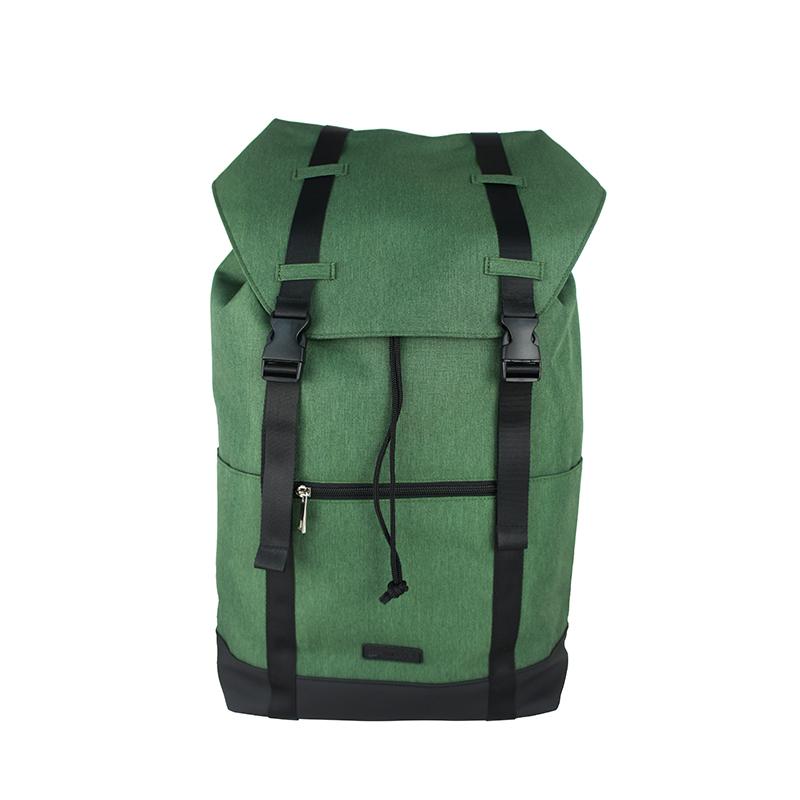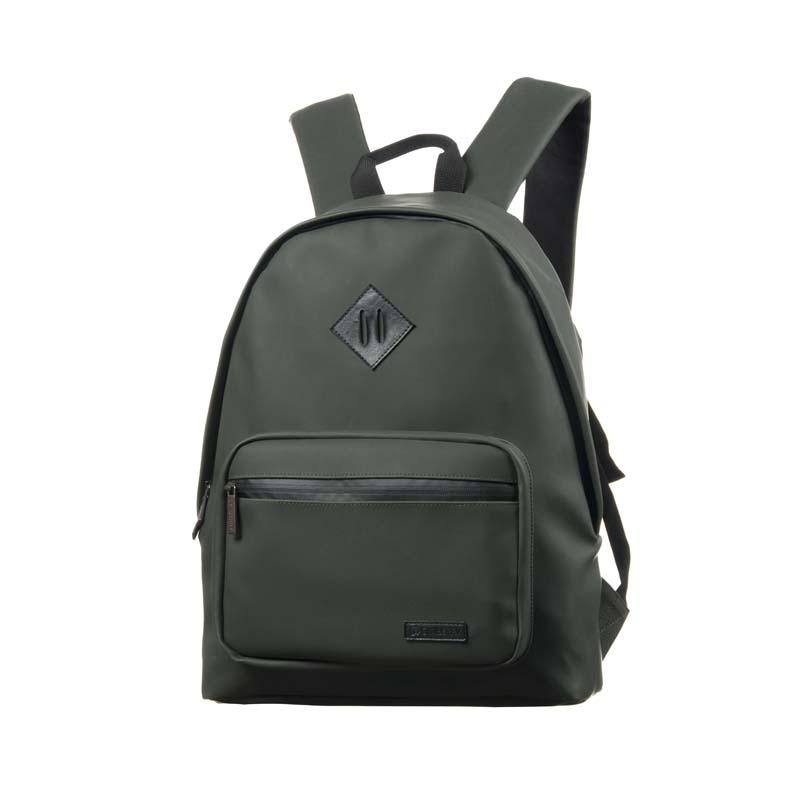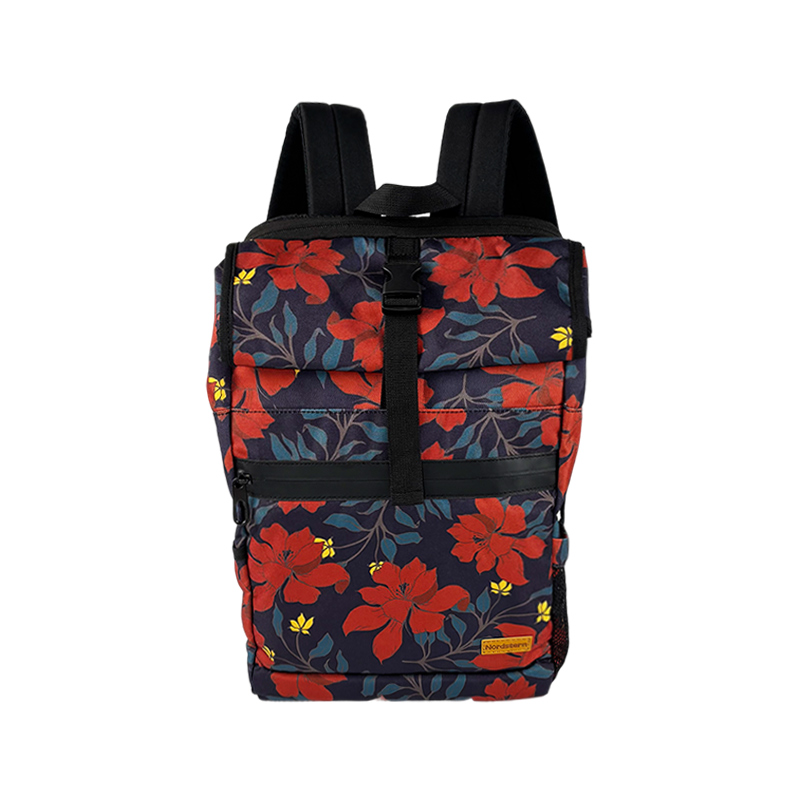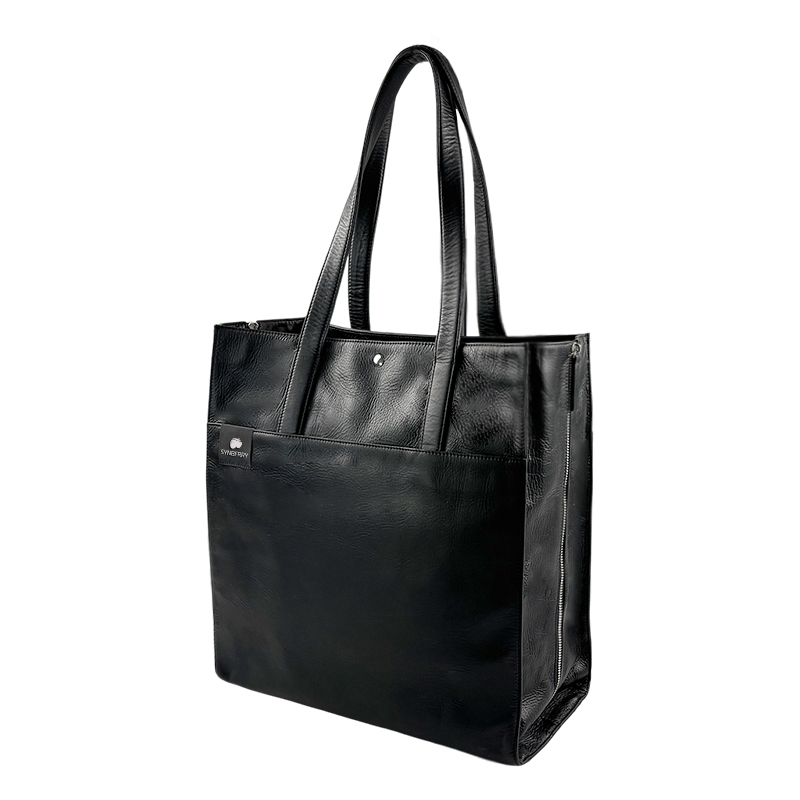



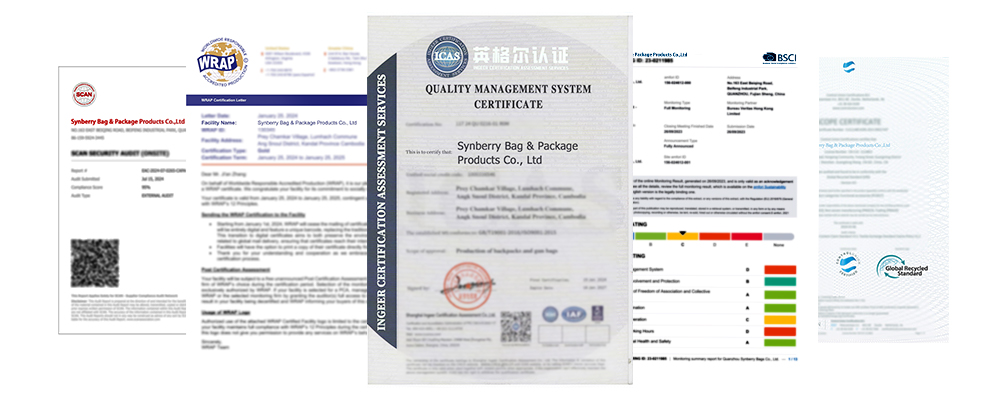
Synberry is gecertificeerd met BSCI, WRAP, SCAN, GRS en ISO, waardoor topkwaliteit en duurzame productienormen worden gegarandeerd.
Onze professionele productaanpassingsservice transformeert uw idee in werkelijkheid en biedt een naadloze ervaring, van het concept tot de productweergave in het winkelschap


Met fabrieken in China en Cambodja heeft u de flexibiliteit om de productielocatie te selecteren die de meest voordelige tariefvoordelen biedt op basis van uw specifieke situatie.

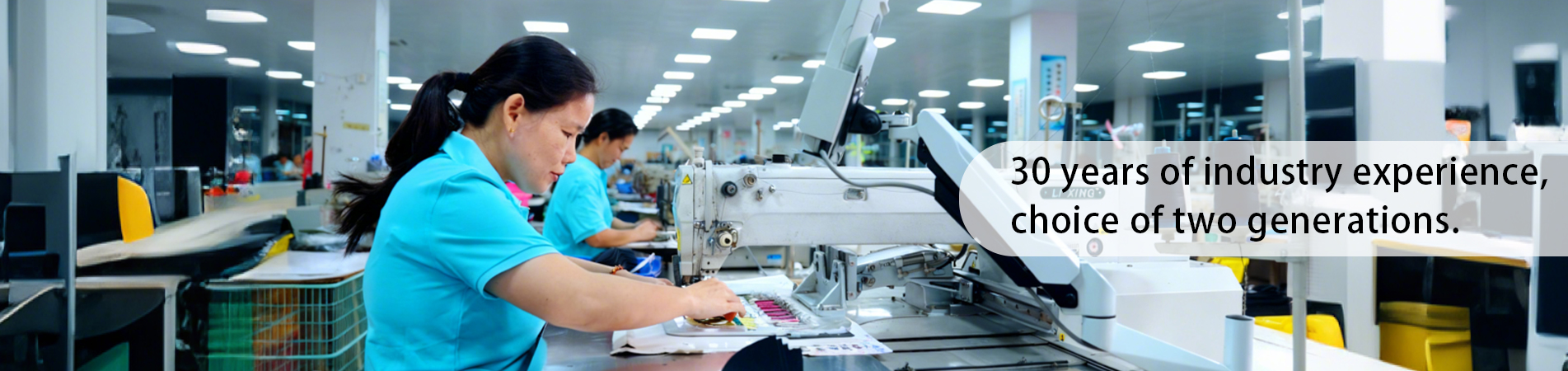
Wat heeft Synberry tot de keuze van twee generaties gemaakt? Met duidelijk gedefinieerde kwaliteitsprincipes, goed beheerde documentatie en dossiers, en vooral, diepgaande procesanalyse en inspectie, zijn we in staat een consistente hoge kwaliteit te garanderen.

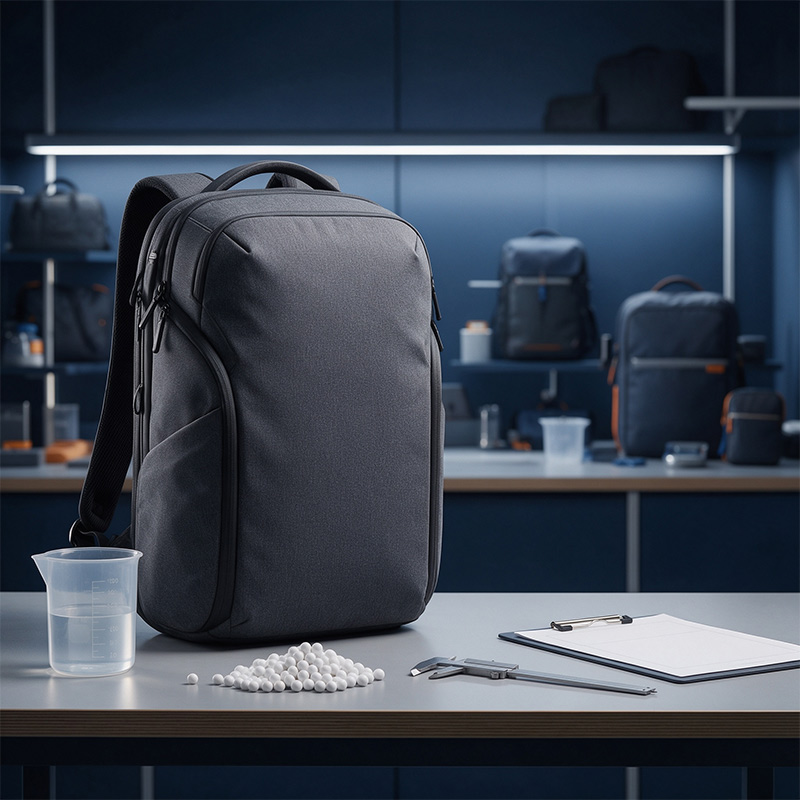
There are two widely used methods for measuring backpack capacity: geometric volume estimation and the ASTM F2153 fill test. During the design stage, the geometric formula (internal length × width × depth ÷ 1,000, multiplied by a pattern correction factor when necessary) can be used to estimate the maximum capacity. For sample approval and production capacity labeling, the unexpanded capacity measured using the ASTM F2153 fill test is generally used as the baseline. Geometric estimation is best suited to structured bags with regular shapes for preliminary space planning. Applying this method directly to sewn backpacks usually overestimates capacity. The fill test uses rigid plastic spheres with a diameter of 20 mm to fill all enclosed compartments; the spheres are then transferred to a calibrated measuring container to determine volume. The result can be used in purchase contracts, technical packs, inspection criteria, and product capacity labeling. For custom bag manufacturing, specifying the measurement method, included compartments, and tolerance alongside the capacity value helps align acceptance criteria between buyers and suppliers. Table of Contents Ⅰ. Why Backpacks with the Same Labeled Capacity Can Have Different Actual Volumes Ⅱ. Geometric Formula Estimation Ⅲ. ASTM F2153 Fill Test Ⅳ. Practical Recommendations for Backpack OEM Projects Ⅴ. Frequently Asked Questions (FAQ) Ⅵ. Conclusion Ⅰ. Why Backpacks with the Same Labeled Capacity Can Have Different Actual Volumes 1. Backpack Capacity Has No Globally Uniform Mandatory Labeling Standard Unlike shoe sizing or fabric weight, backpack capacity is not subject to a globally uniform mandatory labeling rule. Products labeled as 30 L may be measured using four common methods in the industry, producing different usable-volume results. Measurement method What is measured Typical result Notes Multiply external dimensions External length × width × height of the bag Likely to be overstated Counts fabric, foam, and back-panel structures as volume; unsuitable for labeled capacity. Main compartment only Largest enclosed main-compartment space Conservative Perceived usable space may exceed the labeled value, but the scope is limited and comparisons are less meaningful. Add all enclosed pockets Main compartment, zippered pockets, and covered enclosed pockets More comparable Closer to the logic of ASTM F2153; agree in advance whether open pockets are included. Promote expanded capacity Capacity with the roll-top or expansion zipper fully opened Represents maximum expanded state only Volume is lower in the normally closed state; some expanded bags may exceed airline carry-on limits. 2. Main Reasons for Differences in the Same Labeled Capacity For a daypack labeled 30 L, an external-dimension calculation includes space occupied by the back panel and shoulder-strap structure. Under the ASTM F2153 fill test, only enclosed compartments are counted; mesh water-bottle pockets and open front stash pockets are excluded. As a result, the unexpanded measured capacity may be only 24–25 L. Such differences are usually not manufacturing defects. They primarily result from different measurement methods and boundaries for what is included. 3. Capacity Must Be Matched to the Intended Use State Capacity can be reported as unexpanded capacity and expanded capacity. Unexpanded capacity refers to the bag in its normally closed, everyday-use configuration. Expanded capacity is the maximum volume available when a roll-top is fully opened or an expansion zipper is completely unzipped. A specification sheet that lists only one capacity value does not clearly identify the intended use state and makes inspection decisions more difficult. For roll-top bags and bags with expansion zippers, also verify the fully loaded external dimensions to determine whether the bag meets carry-on baggage size limits. Ⅱ. Geometric Formula Estimation 1. Basic Formula and Units A general geometric formula used in backpack OEM development is: Capacity (L) = Internal Length (cm) × Internal Width (cm) × Internal Depth (cm) ÷ 1,000 Example: With internal dimensions of 50 × 30 × 20 cm, the theoretical capacity is 50 × 30 × 20 ÷ 1,000 = 30 L. The formula uses centimeters and returns liters, based on 1 L = 1,000 cm³. For the North American market, capacity may also be listed in cubic inches; 1 L ≈ 61.024 cu in. 2. Appropriate Uses of the Geometric Formula • Reverse-engineering target dimensions during concept design: allocate internal usable dimensions based on the target capacity to support pattern and construction development. • Quickly estimating a capacity range during initial inquiries: when no physical sample is available, use external dimensions to make a preliminary assessment of the product category and support quotation and process evaluation. • Planning internal space before sampling: allocate space among the main compartment, laptop compartment, and front pockets, using the result as a theoretical upper-limit reference. 3. Why the Geometric Formula Can Be Inaccurate for Sewn Backpacks • The bag is not a perfect rectangular prism: daypacks that taper toward the top, roll-top bags, flap-top bags, and packs with curved suspension profiles have irregular shapes that cannot be accurately represented by a rectangular prism. • Fabric, foam, and suspension components reduce usable volume: laptop sleeves, back panels, and shoulder-strap anchor structures occupy space within the bag’s external profile. • Pocket-counting rules vary: external-dimension calculations may include side and front pockets, whereas standard fill testing counts enclosed compartments only and excludes open mesh pockets. • Seam allowances and lining thickness reduce usable space: sewing allowances, lining, and reinforcement materials reduce the effective internal volume. Conclusion: The geometric formula is a design-screening tool for estimating theoretical maximum volume; it should not be used directly as the labeled capacity of a sewn backpack. Results are more accurate for rectangular tote bags and simple travel duffels. For backpacks, technical outdoor packs, and styles with multiple complex compartments, capacity acceptance should be based on a fill test. 4. Early-Stage Estimation Before Sampling: Pattern Correction Factors During early development, before a physical sample is available, a pattern correction factor can help narrow the gap between theoretical and measured capacity. The adjusted formula is: Estimated capacity (L) ≈ [Internal length × internal width × internal depth (cm) ÷ 1,000] × K Select K according to the regularity of the bag’s shape. The ranges below are based on pattern databases and industry experience and are for design estimates only—not for official capacity labeling. The estimate must ultimately be calibrated against an ASTM fill test. Bag construction Reference correction factor Notes Boxy business backpack 0.80–0.85 Regular shape with high space efficiency. Standard daypack 0.75–0.80 Slightly contoured shape and space occupied by compartments. Outdoor hiking pack (internal aluminum-frame back panel) 0.70–0.75 Suspension system takes up more internal volume. Cylindrical duffel 0.72–0.78 Curved side walls reduce usable volume. Roll-top backpack 0.65–0.75 The rolled closure section is excluded from effective capacity. Tapered daypack, narrower at the top 0.70–0.78 The tapered cross-section makes the upper space less efficient. Example: A standard daypack with internal dimensions of 45 × 30 × 18 cm has a theoretical volume of 24.3 L. Using a correction factor of 0.78 gives an estimated capacity of approximately 19 L; subsequent fill testing will generally yield around 18–20 L. Important limitation: Correction factors are not universally transferable across factories or patterns. If the fabric weight or lining construction changes, re-test the bag and recalibrate K. In external technical communications, label this figure as a “design estimate,” not the contractual labeled capacity. Ⅲ. ASTM F2153 Fill Test 1. Standard Overview and Scope A commonly used industry standard for backpack capacity testing is ASTM F2153, “Standard Test Method for Measurement of Backpack Capacity.” It is a voluntary test method intended to establish consistent, comparable capacity-measurement rules among brands, factories, and inspection teams. Key principles: report both unexpanded and expanded capacity; count enclosed compartments only; exclude open mesh water-bottle pockets, open front stash pockets, and open compression pockets. The standard generally does not apply to small bags under 4 L. Crossbody mini bags, waist packs, and small organizers do not need to be labeled in liters; if a capacity value is provided, identify the alternative simplified test method used. 2. Standard Filling and Volume-Reading Procedure Step Procedure Control point 1. Prepare the test media Use uniform rigid plastic spheres with a diameter of 20 mm, commonly PP or PS. Foam beads and beans are for rough internal checks only; they compress or settle and have poor repeatability. Do not use them for official capacity labeling. 2. Fill all enclosed compartments Fill the main compartment and every zippered pocket. For roll-top bags, fill to the agreed number of rolls while ensuring normal closure. Close zippers after filling without pulling them taut. Do not omit any enclosed compartment. Exclude all open pockets. 3. Use a consistent settling procedure Gently shake the bag so the spheres settle naturally. A common procedure is three gentle shakes, approximately 10 seconds each. Do not deliberately press or compress the bag to inflate the reading. 4. Transfer the spheres to a calibrated measuring container Transfer all spheres into a graduated container calibrated by water-volume measurement. Gently agitate until the spheres settle, then record the volume. Large backpacks may be measured in multiple batches and the readings added together. Calibrate measuring equipment with water periodically and retain calibration records. 5. Repeat the test and average the results Conduct at least two independent tests. If the results differ by more than 1–2 L, filling or settling procedures may not have been consistent; repeat the test. Use the same spheres and measuring equipment for first-piece, in-line, and final inspections. 3. Limitations of the Standard and Its Relationship to Specification Sheets ASTM F2153 is voluntary and is not legally mandatory. Many retail product listings also omit the test method. The value of the test is that it allows the fill media, measuring equipment, included compartments, and tolerances to be defined in the specification sheet. If only a capacity number is listed without test details, results from different stages cannot be reliably compared. 4. When Full Laboratory Equipment Is Unavailable: Simplified Measurement Methods Not every inspection site has enough standard plastic spheres and calibrated measuring containers. A simplified method may be used during sampling, but the specification sheet must state that it differs from ASTM F2153. Scenario Simplified method Notes Compartments of 4 L or more Fill with 20 mm plastic spheres or uniform dry beans, then measure using a 1 L measuring cup and add the readings. Beans are for internal reference only; rigid plastic spheres are preferred for official capacity labeling. Compartments under 4 L Because small spheres stack with greater error, weigh the filling material first and convert to volume using a defined ratio if necessary. State in the documentation: “Not the ASTM F2153 standard procedure.” Curved or tapered bags Fill in vertical sections and add the readings from each section. A single rectangular-prism calculation will overestimate the capacity of tapered bags. Backpacks with multiple compartments Fill and measure each enclosed compartment separately, then total the results; list open pockets separately as excluded. Keep separate records to avoid confusion over what is included. Important: Capacity values obtained using different measurement methods should not be compared directly. Ⅳ. Practical Recommendations for Backpack OEM Projects 1. Recommended Capacity Fields for Specification Sheets To reduce the risk of a finished product’s capacity differing from expectations, include the following six items in the capacity section of the specification sheet: Field Recommended wording Purpose Measurement method “ASTM F2153 fill test using 20 mm PP spheres” / “Calculated from external dimensions; design reference only.” Identifies the method used to determine capacity. Unexpanded capacity Capacity in liters in the normally closed state. Matches typical use and product labeling. Expanded capacity Capacity in liters with the expansion zipper fully open or the roll-top fully unrolled. Distinguishes maximum expanded volume. Compartments included “Includes the main compartment and all zippered pockets; excludes mesh water-bottle pockets and open front stash pockets.” Removes ambiguity about which pockets count. Units List L and cu in together and specify the conversion. Supports reading preferences in different Western markets. Tolerance Agree on a tolerance by capacity range; use the same test method when judging compliance. Sets a reasonable acceptance range for inspection. 2. Example Wording for a Specification Sheet Capacity: 28 L unexpanded (approx. 1,709 cu in) / 34 L expanded (approx. 2,075 cu in), measured using the ASTM F2153 fill test with 20 mm PP plastic spheres. Includes the main compartment and all zippered pockets; excludes mesh water-bottle pockets and open front stash pockets. Tolerance: ±1.5 L. File the test record with the initial sample approval documents. 3. Suggested Tolerances and Contract Language Capacity range Suggested tolerance Application notes Under 20 L ±1 L Small bags are sensitive to compartment and opening design; test conditions must be controlled. 20–40 L ±1.5–2 L Common range for daypacks and commuter laptop backpacks. Over 40 L / large travel bags ±2–3 L Fill-test variation may be greater for large bags; additional repeats are recommended. Retail products with strict controls ±3%, or agree that “labeled capacity must not exceed measured unexpanded capacity.” Suitable for tightly controlled cross-border retail programs. Note: Tolerance criteria must correspond to the capacity test method. A tolerance established using external dimensions cannot be used to judge results from a fill test. 4. Common Capacity-Related Discrepancies in Custom Backpack Development Type of discrepancy Explanation Control measure Including open pockets in labeled capacity The counting method differs from ASTM and can produce inconsistent figures. Clearly list included and excluded pockets in the specification sheet. Advertising only expanded capacity Does not reflect volume in the product’s normally closed state. Provide both unexpanded and expanded capacity. Using external dimensions directly for sewn backpacks Foam, back panels, and lining take up space, so the calculated value is high. Use fill testing as the basis for labeled capacity; use external dimensions only as a supplementary reference. Using one capacity value for all sizes of a style Pattern and suspension structures change by size, affecting volume. Test each size independently. Testing only the first sample, with no production recheck Pattern adjustments, lining changes, and pocket revisions can change capacity. Test the approved reference sample and production trial units. Mixing metric and imperial units without labels Can lead to misinterpretation of readings. List both L and cu in in technical documents, with the primary unit suited to the target market. 5. Key Points When Comparing Multiple Samples Two products labeled with the same capacity may not perform equally in actual loading. Compare external dimensions, the main compartment’s internal usable dimensions, opening design, and photos of the bag when loaded. Even when both are labeled 30 L, a boxy pack and a tapered pack may accommodate different shapes of items. For travel backpacks and school backpacks, capacity is only one consideration. Flap-top designs are better suited to flat items, while top-loading roll-top bags offer good compression but can make items deep inside the bag harder to access. For a more complete assessment, include capacity, main-compartment internal dimensions, opening type, and fully loaded external dimensions in the specification sheet. 6. When to Conduct Capacity Tests Lock in the capacity baseline during initial sample approval. Once the first sample is complete, test capacity using the agreed method. After the parameters are approved, record them in the technical pack and purchasing documents before starting mass production. During inspection, use the same sphere specifications, measuring equipment, and settling procedure as for the approved sample, and assess the results against the agreed tolerance. 7. Capacity Records and Compliance Documentation Capacity testing is a technical specification activity and is separate from chemical testing of materials. Nevertheless, related records should be archived together for easy reference. If a product is labeled as using recycled fabric, the material claims should align with applicable GRS, GOTS, or OEKO-TEX documentation. Children’s backpacks sold in the United States must also meet applicable CPSIA requirements. A substantial discrepancy between labeled and measured capacity may create a risk of misleading advertising in the US and European markets. Store capacity test records and compliance certificates in the technical pack so they can be retrieved for customer factory audits and marketplace reviews. Ⅴ. Frequently Asked Questions (FAQ) Q1: Is backpack capacity accurately measured by multiplying length × width × height and dividing by 1,000? This formula estimates only the theoretical upper limit. It counts fabric, foam, and back-panel structures as volume and therefore generally overestimates usable space in sewn backpacks. The discrepancy is smaller for rectangular tote bags and simple travel duffels. For backpacks, outdoor packs, and styles with multiple compartments, capacity acceptance should be based on the ASTM F2153 fill test. A pattern correction factor can support early sampling estimates, but the result is for internal reference only and must not be used as the official labeled capacity. Q2: What is ASTM F2153? Are factories required to use it? ASTM F2153 is a voluntary test method for measuring backpack capacity; it is not legally mandatory. The core procedure is to fill all enclosed compartments with 20 mm rigid plastic spheres, transfer the spheres to a calibrated measuring container, and record both unexpanded and expanded capacity. Open water-bottle pockets and open stash pockets are excluded. The buyer and supplier should agree on whether to use the method in the technical documentation; once agreed, it becomes the basis for acceptance. Q3: Why does a factory label a backpack as 30 L when the fill-test result is only 25 L? This is usually due to differences in measurement methods—for example, using external dimensions or including open pockets in the calculation. A difference of around 20% between a daypack’s labeled capacity and its ASTM fill-test result is not unusual in the industry. Buyers and suppliers can establish a consistent basis for acceptance by agreeing in advance on the test method, pocket-inclusion rules, and tolerance range in the specification sheet. Q4: How should tolerances be set in a specification sheet, and which units should be used? For bags under 20 L, a tolerance of ±1 L is suggested; for 20–40 L, ±1.5–2 L; and for large bags over 40 L, ±2–3 L. For tightly controlled retail programs, the tolerance can be narrowed to ±3%, or the parties can agree that “the labeled capacity must not exceed the measured unexpanded capacity.” Use cubic inches (cu in) alongside liters for North America, while liters are generally preferred in Europe. Conversion: 1 L ≈ 61.024 cu in. Q5: How should capacity be tested for small bags under 4 L, waist packs, and organizers? ASTM F2153 generally does not apply to bags under 4 L. A simplified method can use a calibrated measuring cup, uniform dry beans, or a weight-to-volume conversion. The specification sheet must state that the method is “not the ASTM F2153 standard procedure.” Small spheres can stack inconsistently in small compartments, so external capacity claims for small bags should be made cautiously. Q6: Can rice or beans replace standard plastic spheres? They may be used for rough internal checks, but capacity figures used in contracts, specification sheets, or product labeling should not be based on rice or beans. Grains settle under pressure, and results vary between operators and batches, making repeatability poor. For formal testing, use 20 mm rigid PP/PS spheres and calibrated measuring equipment. Q7: For a roll-top backpack, how many rolls count as the unexpanded state under ASTM F2153? ASTM F2153 does not mandate a specific number of roll-top folds, which can lead to disagreement for this style. The buyer and supplier should agree in writing in the technical pack on the number of folds used for normal closure (commonly 2–3 rolls in the industry). Fill the bag to the agreed number of rolls and confirm that it closes normally without fabric tension; record this as the unexpanded capacity. The reading with the roll-top fully unrolled is the expanded capacity. Ⅵ. Conclusion From using geometric estimates to support early pattern planning, to determining labeled capacity through ASTM F2153 fill testing, and then specifying the test method, included compartments, and tolerances in clear technical terms, a verifiable capacity-assessment system is central to bag capacity management. Consistent criteria help project stakeholders avoid misunderstandings about specifications. As a professional bag manufacturer, we can support capacity-related technical requirements and help align project specifications with the agreed standards. Please contact us if you need assistance. Author
BEKIJK MEER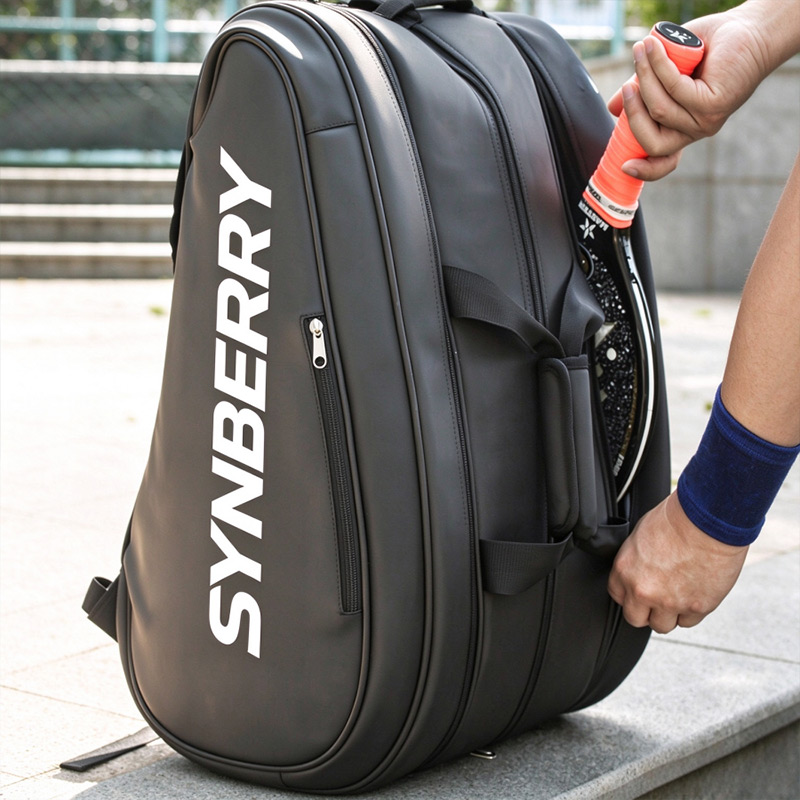
Een goede pickleballtas moet aan vier kerneisen voldoen: een wetenschappelijk ontworpen compartimentindeling, een comfortabel draagsysteem, hoogwaardige afwerking en duurzame, waterbestendige materialen. Pas als aan al deze vier elementen is voldaan, kan een pickleballtas echt als een goede tas worden beschouwd.Inhoudsopgave:Wetenschappelijk compartimentontwerpComfortabel draagsysteemVakmanschap van hoge kwaliteitDuurzame, waterbestendige materialenAanbevelingen voor personalisatie voor merkenVeelgestelde vragen over het personaliseren van pickleballtassenConclusie 1. Ontwerp van wetenschappelijke compartimentenDe slagvlakken van pickleballrackets zijn voornamelijk gemaakt van koolstofvezel of glasvezelcomposiet, materialen die gevoelig zijn voor druk, krassen en langdurige blootstelling aan hoge temperaturen en direct zonlicht. Daarom is een speciaal vak voor het racket een essentieel onderdeel van een goede pickleballtas.Een uitstekend peddelvak moet specifiek de volgende kenmerken hebben:Verdikt, geïsoleerd peddelvak: Het speciale peddelvak moet voorzien zijn van een verdikte laag EVA of parelkatoen om schokken op te vangen wanneer de tas valt of wordt samengedrukt. Daarnaast, een thermische isolatiebekleding van aluminiumfolie Kan effectief hoge buitentemperaturen weerstaan en helpt vervorming van het peddelblad te voorkomen die wordt veroorzaakt door langdurige blootstelling aan direct zonlicht.Groot hoofdcompartiment: Het hoofdcompartiment moet voldoende ruimte bieden voor alle essentiële uitrusting die nodig is voor dagelijkse trainingen of wedstrijden, zoals kleding, handdoeken, waterflessen en andere spullen.Snel toegankelijk ballenvak: Voeg een speciaal vak van gaas of elastiek toe aan het hoofdvak voor het opbergen van pickleballen. Het aparte, snel toegankelijke ballenvak houdt de ballen fysiek gescheiden van de kleding, wat bijdraagt aan de netheid en organisatie van de uitrusting. Het stelt spelers ook in staat om snel bij reserveballen te komen tijdens de warming-up of tussen wedstrijden, zonder het hele hoofdvak te hoeven doorzoeken. Dit verbetert de algehele efficiëntie en het gebruiksgemak.Apart, geventileerd schoenenvak: Dit vak is afgescheiden van het hoofdcompartiment en voorkomt dat natte of vuile schoenen de rackets en kleding bevuilen, terwijl het ook helpt om onaangename geuren te verminderen. Dit is een belangrijk kenmerk dat een professionele pickleballtas onderscheidt van een gewone sporttas.Meerdere kleine vakjes: Ontworpen voor het opbergen van persoonlijke spullen en accessoires zoals mobiele telefoons, sleutels, handvatten, beschermende uitrusting en handdoeken.Verborgen vak voor waardevolle spullen: Voorzien van een zachte, met suède gevoerde binnenkant om waardevolle spullen die gevoelig zijn voor krassen veilig op te bergen. 2. Comfortabel draagsysteemPickleballtassen zijn er doorgaans in drie draagstijlen: rugzakken, schoudertassen/crossbodytassen en converteerbare tassen die zowel in de hand als als rugzak gedragen kunnen worden. Rugzak: Ideaal voor het vervoeren van meerdere peddels en een complete uitrusting. De belangrijkste kenmerken zitten in het ontwerp van de schouderbanden en het rugpand. De schouderbanden van een hoogwaardige rugzak moeten breed en dik zijn, gevuld met schuim met een hoge dichtheid en bedekt met ademend mesh-materiaal om de druk over de schouders te verdelen en de luchtcirculatie te bevorderen. Dit voorkomt overmatige warmteophoping en drukplekken bij langdurig dragen. Het rugpand moet een verstevigende laag van EVA of PE-parelkatoen bevatten om vervorming of inzakken onder zware belasting te voorkomen. Het moet zich ook aanpassen aan de natuurlijke kromming van de wervelkolom, voor stabiele en betrouwbare ondersteuning.Schoudertassen of crossbodytassen: Bij deze tassen ligt de nadruk op lichtgewicht gemak en flexibiliteit, waardoor ze ideaal zijn voor korte trainingssessies of situaties waarin slechts een kleine hoeveelheid spullen nodig is. De schouderband moet breed genoeg zijn om afglijden te voorkomen, terwijl het schouderstuk een dempende laag moet hebben om de belasting van het dragen van gewicht op één schouder te verminderen. Een verstelbare schouderband zorgt ervoor dat gebruikers van verschillende lengtes een comfortabele pasvorm kunnen vinden.Convertibele draagtas en rugzak: Voor gebruikers die veelzijdigheid waarderen, biedt een convertibele draagtas en rugzak meer flexibiliteit. Dit type tas heeft doorgaans een verstevigd handvat aan de bovenkant voor gemakkelijk dragen over korte afstanden of om de tas in een voertuig te plaatsen, evenals een gewatteerd handvat aan de zijkant dat is ontworpen om de druk op de hand te verminderen en ongemak te voorkomen tijdens het dragen van de tas.In de rugzakmodus moeten de verborgen schouderbanden gemakkelijk uit te trekken en stevig vast te maken zijn, waardoor in beide configuraties een soepele draagervaring gegarandeerd is. Ongeacht de gekozen stijl is het uiteindelijke doel van het draagsysteem ervoor te zorgen dat spelers zich comfortabel en op hun gemak voelen op weg naar en van de tennisbaan. 3. Hoogwaardig vakmanschapDe details van het vakmanschap bepalen direct de levensduur en het algehele uiterlijk en gevoel van een pickleballtas.Stiksels: De stiksels moeten sterk en duurzaam zijn, met een gelijkmatige steekafstand en nette, gelijkmatige naden. Belangrijke spanningspunten, zoals de bevestigingspunten van de schouderbanden, de basis van de handvatten en de uiteinden van de ritsen, moeten worden versterkt met dubbele of zelfs driedubbele stiksels, in combinatie met spijker Versteviging om de scheurweerstand te verbeteren en te voorkomen dat naden splijten of breken onder langdurige zware belasting.Beslag: De keuze van het beslag is cruciaal. Ritsen moeten soepel, duurzaam en waterafstotend zijn, bij voorkeur van gerenommeerde merken zoals YKK of SBS. Ritstrekkers moeten gemakkelijk vast te pakken en te bedienen zijn, zelfs met sporthandschoenen aan.Gespen: Gespen moeten een vermoeiingstest ondergaan om te garanderen dat ze bestand zijn tegen scheuren of vervorming, zelfs na herhaaldelijk vast- en losmaken. Daarnaast moeten de randen van de stof netjes afgewerkt zijn, zonder losse draden, en moet de tas een gestructureerde, goed gedefinieerde vorm behouden zonder gemakkelijk in te zakken, zelfs wanneer hij leeg is. Deze details getuigen van professionele kwaliteit en aandacht voor detail. 4. Duurzame, waterbestendige materialenPickleball wordt vaak buiten gespeeld, waar tassen blootgesteld kunnen worden aan plotselinge regenbuien of ochtenddauw op de baan. Daarom is de waterafstotende stof de eerste verdedigingslinie om de uitrusting binnenin te beschermen. 4.1 Hoofdstof: Nylon versus polyesterEen hoogwaardige pickleballtas moet gemaakt zijn van nylon met een hoge dichtheid (zoals 600D of hoger) of polyester. Deze materialen bieden een uitstekende slijtvastheid en scheurweerstand, en zijn bovendien waterafstotend.Nylon: Bij een vergelijking tussen deze twee veelgebruikte materialen valt nylon op door zijn hogere sterkte-gewichtsverhouding en uitstekende slijtvastheid, waardoor het een voorkeurskeuze is voor hoogwaardige pickleballtassen. Het heeft een glad oppervlak en voelt zacht aan, maar is wel relatief duurder.Polyester: Polyester biedt een betere UV-bestendigheid en kleurechtheid, waardoor het minder snel vervaagt of beschadigd raakt na langdurige blootstelling aan direct zonlicht. Het is bovendien voordeliger, wat het een kosteneffectieve keuze maakt. 4.2 Waterdichte coatingsEen basis van hoogwaardige stof alleen is niet voldoende om barre weersomstandigheden te weerstaan. De waterdichtmakende behandeling van het oppervlak is de belangrijkste factor die de waterafstotende eigenschappen van een tas bepaalt. De meeste professionele pickleballtassen die tegenwoordig op de markt zijn, gebruiken een van de drie belangrijkste behandelingen: DWR (Durable Water Repellent) coating, PU-coating of TPU-coating.DWR-waterafstotendheid: De DWR-coating creëert een lotusbladeffect op het oppervlak van de tas, waardoor waterdruppels zich tot parels vormen en er snel afrollen in plaats van in de stof te dringen. Dit voorkomt effectief dat regenwater de spullen binnenin doorweekt.Waterdichte PU-coating: Een PU-coating wordt doorgaans aan de binnenzijde van de stof aangebracht en vormt een dicht waterdicht membraan. Dit voorkomt niet alleen dat vocht van buitenaf binnendringt, maar verbetert ook de algehele structuur en scheurweerstand van de stof.Waterdichte TPU-coating: TPU is een thermoplastisch polyurethaan-elastomeer dat doorgaans als een dunne film op de binnenzijde van de stof wordt gelamineerd of als een aparte laag wordt aangebracht. In vergelijking met PU-coating biedt TPU een superieure hydrolysebestendigheid en flexibiliteit bij lage temperaturen. Zelfs in koude en vochtige omgevingen is het minder gevoelig voor degradatie, uitharding of scheuren, waardoor de waterdichtheid van de tas ook bij langdurig gebruik behouden blijft. 5. Aanbevelingen voor personalisatie voor merkenAls u van plan bent een pickleballtas onder uw eigen merk te ontwikkelen, kunnen de volgende aanbevelingen op drie belangrijke gebieden u helpen de juiste balans te vinden tussen productprestaties, kosten en doelgroep. 5.1 Aanbevelingen voor de belangrijkste stofkeuzeHet materiaal bepaalt het uiterlijk, de kwaliteit, de duurzaamheid en de prijs van een pickleballtas. De volgende tabel geeft aanbevelingen voor de materiaalkeuze op basis van de productpositionering.StofoptieAlgemene specificatiesSterkte / SlijtvastheidUV-bestendigheidKostenAanbevolen positioneringPolyester600D / 900D★★★☆★★★★☆ (kleurvast)GematigdVoordelige modellen, instapmodellen en producten voor langdurige blootstelling aan de zon buitenshuis.Nylon600D / 1680D ballistisch nylon★★★★★ (sterk en lichtgewicht)★★★ (UV-behandeling aanbevolen)Middelmatig tot hoogMidden- tot hoogwaardige modellen en tassen voor professionele spelersNylon + Ripstop / JacquardGeruit nylon, honingraatstructuur★★★★★★★★HoogPremium modellen en designermerkenSamengesteld gaasweefsel (PVC/EVA)500D–1000D★★★★☆★★★☆GematigdVerbeterde waterdichte modellen en tassen voor strand of multifunctioneel gebruik.Belangrijke selectiecriteria:Voor modellen die in grote aantallen worden verkocht, is 600D polyester de beste keuze. Het materiaal biedt beheersbare kosten en een goede kleurechtheid, waardoor het een populaire keuze is voor gangbare instapmodellen.Voor modellen in het midden- tot hogere segment kunt u 1000D of 1680D ballistisch nylon overwegen. De hoge sterkte en goede waterbestendigheid maken het geschikt voor dit marktsegment.Milieuvriendelijke opties: Overweeg gerecycled nylon, zoals ECONYL®, of gerecycled polyester (RPET), en steun internationaal erkende certificeringen zoals GRS om te voldoen aan de groeiende vraag naar duurzame producten op de Europese en Noord-Amerikaanse markten. 5.2 Aanbevelingen voor capaciteitsselectieGroter is niet altijd beter als het om capaciteit gaat. De ideale maat moet aansluiten bij de speelomstandigheden en draaggewoonten van de beoogde gebruikers. De volgende tabel geeft aanbevelingen voor de capaciteit van pickleballtassen die door OEM's worden ontwikkeld.CapaciteitscategoriePeddelcapaciteitTypische configuratieDoelgroepReferentieafmetingen (L × B × H)Lichtgewicht model1–2 peddelsHoofdvak + ballenvak + bidonhouder; meestal geen schoenenvakRecreatieve spelers en mensen die wandelen combineren met pickleball spelen.Ca. 45 × 20 × 25 cmStandaardmodel (aanbevolen)2–4 peddelsGevoerd peddelvak + hoofdvak + apart schoenenvak + balvak + vakjes voor kleine spullenKernleden van de club en vaste dubbelspelersCa. 50 × 25 × 32 cmProfessioneel model met grote capaciteit4–6 peddelsGevoerd peddelvak + groot hoofdvak + apart schoenenvak + balvak + waterdichte opbergtasProfessionele spelers en coachesCa. 55 × 30 × 38 cmReis-/teammodel6 of meer peddelsrolkoffer of extra grote rugzak met bevestigingssystemen aan de buitenkantTeams die grote hoeveelheden inkopen en spelers die vaak reizenCa. 60 × 35 × 45 cmBelangrijke selectiecriteria:Het standaardmodel is de ideale keuze. Een tas voor 2 tot 4 rackets is geschikt voor een breed scala aan spelers. Merken die een nieuwe productlijn pickleballtassen ontwikkelen, zouden deze capaciteit als hun vlaggenschipmodel moeten overwegen.Lichtgewicht modellen zijn ideaal voor het werven van klanten of als relatiegeschenk. Dankzij hun eenvoudige constructie en lagere prijs zijn ze geschikt als aanvulling op instapsets of als aandenken voor clubevenementen, waardoor de drempel voor nieuwe spelers wordt verlaagd.Professionele modellen met grote capaciteit moeten prioriteit geven aan opslagefficiëntie in plaats van simpelweg meer ruimte te bieden. Om de uitdaging aan te gaan van het organiseren van de uitgebreide uitrusting die coaches en professionele spelers meenemen, kunnen verwijderbare tussenschotten of modulaire binnenvakken worden overwogen. Deze functies stellen gebruikers in staat om verschillende combinaties van rackets en kleding op te bergen, terwijl de binnenkant overzichtelijk blijft.Bij reis-/teammodellen is het belangrijk dat de nadruk ligt op reisvriendelijke eigenschappen. Naast een extra grote capaciteit moeten ze een standaard bagageband en slijtvaste beschermvoetjes bevatten. Deze eigenschappen zorgen ervoor dat de pickleballtas stevig aan een koffer vastzit tijdens transfers op de luchthaven en lange reizen, en verminderen slijtage aan de onderkant van de tas. 6. FAQ: Veelgestelde vragen over het personaliseren van pickleballtassen Vraag 1: Wat is het verschil tussen een pickleballtas en een tennistas? Kunnen ze door elkaar gebruikt worden?Ze kunnen tijdelijk door elkaar gebruikt worden, maar het is niet aan te raden. Pickleball rackets (ongeveer 40 cm lang) zijn korter dan tennisrackets, waardoor er in tennisracketvakken te veel lege ruimte overblijft. Hierdoor kunnen rackets verschuiven en tegen andere spullen botsen. Pickleballtassen hebben doorgaans ook speciale vakken voor ballen, omdat harde plastic pickleballs beschadigd kunnen raken door te veel druk. Daarnaast zijn er vaak vakken voor schoenen en andere opbergruimtes voor kleine spullen. Als je alleen pickleball speelt, biedt een speciale pickleballtas een aanzienlijk betere gebruikservaring. Vraag 2: Hoe kan ik de waterdichtheid van een tas bepalen? Betekent waterafstotendheid dat de tas waterdicht is?Nee. De waterafstotende werking van een DWR-coating is over het algemeen voldoende voor lichte regen en spatten, maar er kan nog steeds water door de ritsen sijpelen. Voor een meer complete waterdichte bescherming heeft de tas een combinatie nodig van PU/TPU-gecoate stof of gelamineerde waterdichte stof en waterdichte ritsen, zoals die van YKK. Controleer bij het winkelen of in de productspecificaties zowel de stofcoating als de waterdichte ritsen worden vermeld. Vraag 3: Waarom is thermische isolatie nodig in het compartiment van een pickleballracket? Kan de zomerhitte een racket echt beschadigen?Ja. Pickleball rackets met een slagvlak van koolstofvezel of glasvezel en een honingraatkern van polypropyleen kunnen na langdurige blootstelling aan hoge temperaturen en direct zonlicht zachter worden, delamineren of een ander speelgevoel krijgen. Een thermische isolatievoering van aluminiumfolie kan de temperatuur in de tas aanzienlijk verlagen, waardoor dit een van de belangrijkste kenmerken is die een professionele pickleballtas onderscheidt van een budgetmodel. Vraag 4: Wat is de gebruikelijke minimale bestelhoeveelheid (MOQ) en levertijd voor pickleballtassen op maat?De standaard minimale bestelhoeveelheid (MOQ) van SYNBERRY is ongeveer 500 stuks. De levertijd voor samples is afhankelijk van de complexiteit van het ontwerp en bedraagt doorgaans 2-3 weken. De levertijd voor massaproductie varieert afhankelijk van de bestelhoeveelheid en de complexiteit van de productie. Houd rekening met extra tijd voor speciale processen, zoals full-surface printing, reflecterende strips en op maat gemaakte gespen. Vraag 5: Moet ik nylon of polyester kiezen voor een pickleballtas? Welk materiaal is duurzamer?Beide materialen zijn duurzaam, maar bieden elk hun eigen voordelen. Nylon is sterker en voelt prettiger aan, waardoor het geschikt is voor producten in het midden- tot hogere segment. Polyester biedt een betere UV-bestendigheid, een superieure kleurechtheid en een lagere prijs, waardoor het ideaal is voor budgetvriendelijke modellen die langdurig aan de zon worden blootgesteld. Kies nylon als uw budget het toelaat; kies polyester als prijs-kwaliteitverhouding uw prioriteit is. 7. ConclusiePickleball kent een explosieve groei in deelname wereldwijd, en pickleballtassen ontwikkelen zich van accessoire tot een gespecialiseerde productcategorie. Voor sporttassenmerken biedt dit niet alleen een kans om een opkomende markt te betreden, maar ook een cruciale mogelijkheid om professionele merkherkenning op te bouwen door middel van verfijndere productontwikkeling.Een uitstekende pickleballtas moet meer zijn dan een verzameling opbergvakken. Hij moet getuigen van een diepgaand begrip van de behoeften van de gebruiker en een doordacht antwoord bieden op hun verwachtingen. Van thermische isolatietechnologie die dure rackets beschermt, tot compartimentindelingen die de toegankelijkheid verbeteren, tot weerbestendige materialen die ontworpen zijn voor buitengebruik: elk detail getuigt van respect voor de sportieve beleving van de speler.Dit artikel is geschreven vanuit het perspectief van een fabrikant van pickleballtassen, met als doel merken die productlijnen voor pickleballtassen ontwikkelen een uitgebreide handleiding te bieden, van het begrijpen van klantbehoeften tot het in productie nemen van producten. Auteur
BEKIJK MEER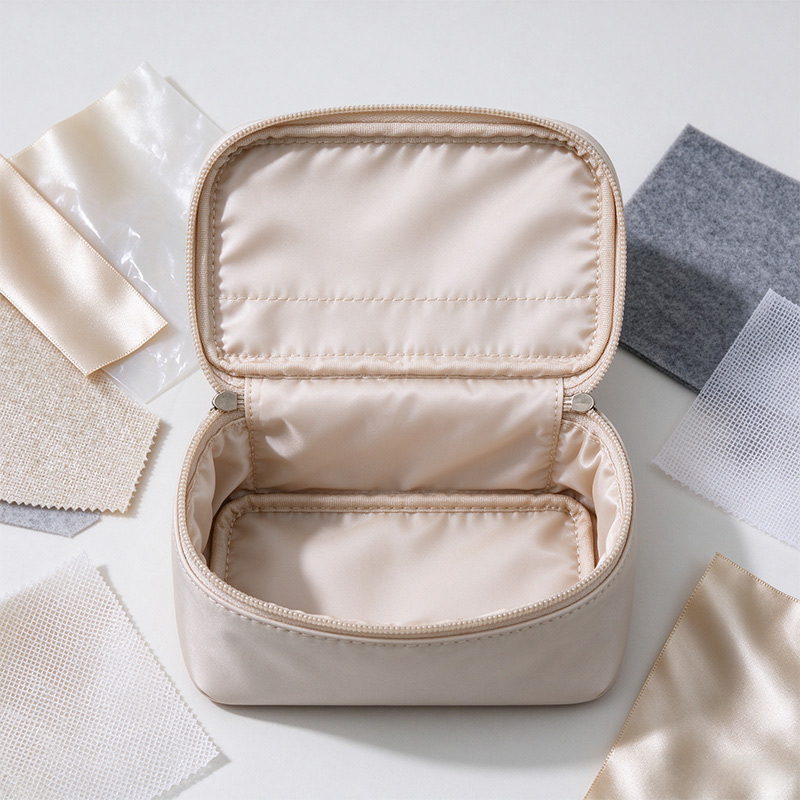
De meest gebruikte materialen voor de voering van cosmetische tassen zijn stoffen op basis van polyester, met name polyester platbinding, polyester taft, pongee en gecoat polyester. Daarnaast worden nylon, TPU, PEVA, PVC en EVA vaak gebruikt voor producten met hoge eisen aan waterdichtheid en lekdichtheid; RPET gerecycled polyester en gerecycled nylon zijn geschikt voor duurzame merken; microvezel, imitatie suède, fluweel en satijn zijn geschikt voor een luxe uitstraling en als cadeau. Katoen, canvas, katoen-polyester mengsels en katoen-linnen mengsels kunnen ook gebruikt worden voor de voering van cosmetische tassen, met name voor canvas tassen, tassen in een natuurlijke stijl, milieuvriendelijke producten of producten die een geborduurde textuur vereisen. De waterdichtheid, vlekbestendigheid en het gemakkelijke reinigen verschillen echter doorgaans van gecoate synthetische stoffen en moeten worden beoordeeld op basis van de specifieke gebruikssituatie. Inhoudsopgave:• Selectie op basis van functionele vereisten• Belangrijke technische parameters voor de selectie van bekleding• Processen voor het aanpassen van de voering en methoden voor het presenteren van het logo• Hoe garanderen we een volledige kwaliteitscontrole van materialen gedurende het gehele productieproces voor onze merken?• Veelgestelde vragen• Conclusie I. Selectie op basis van functionele eisen en analyse van gangbare stoffenBij de keuze van de voering voor een make-uptasje spelen vaak factoren een rol zoals vlekbestendigheid en waterdichtheid, bescherming van de cosmetica, gemakkelijke reiniging en vormvastheid en ondersteuning. In het volgende gedeelte worden de voeringen gecategoriseerd op basis van functionele eisen en worden de kenmerken, toepassingsscenario's en voorzorgsmaatregelen van veelgebruikte stoffen uitgelegd. 1. Waterdichte en gemakkelijk te reinigen categorie• PVC/TPU-folie: Veel gebruikt voor functionele cosmetische tassen en compartimenten voor natte en droge producten, met uitstekende water- en lekvrije eigenschappen. Vloeistoffen zijn gemakkelijk schoon te vegen na spatten. PVC biedt uitstekende waterdichtheid en transparantie, maar de risico's met betrekking tot naleving van REACH en Prop 65 moeten zorgvuldig worden geëvalueerd voor de Europese en Amerikaanse markt. TPU presteert over het algemeen beter op het gebied van milieuvriendelijkheid, UV-bestendigheid en flexibiliteit, waardoor het de voorkeur geniet voor hoogwaardige waterdichte producten.• PEVA: Chloorvrij, een milieuvriendelijk alternatief voor PVC, met goede waterdichtheid en gemakkelijk af te vegen eigenschappen, geschikt voor merken met duurzaamheidseisen. Langdurige blootstelling aan UV-straling kan lichte vergeling veroorzaken, wat tijdens de monsternamefase moet worden beoordeeld.• EVA: Wordt veel gebruikt voor stijve binnenbakken of voorgevormde voeringen, met goede waterdichtheid en structurele ondersteuning, geschikt voor de binnenkant van cosmetische tassen die vormvastheid vereisen.• Gecoat polyester en gecoat Oxford-doek (bijv. PU-coating, TPU-coating): Na het aanbrengen van een coating op polyester of Oxford-doek vormt zich een doorlopende film op het voeringoppervlak, die effectief voorkomt dat vloeistoffen zoals vloeibare foundation en huidverzorgingsproducten binnendringen. Slijtvast en scheurbestendig, met een goede prijs-kwaliteitverhouding, geschikt voor betaalbare make-uptassen met grote capaciteit en functionele tassen voor dagelijks gebruik. Houd er rekening mee dat coatings en stiksels niet volledig waterdicht zijn.• Polyester platbinding, pongee, polyester taft: Stabiele levering, hoge snij- en naai-efficiëntie en stabiele kleurechtheid, waardoor de kleur van de voering consistent blijft tussen verschillende batches bij bulkbestellingen. Polyester taft is lichtgewicht en heeft een hoge dichtheid, is glad en scheurbestendig, en licht van gewicht; pongee en platbinding zijn geschikt voor massaproductie. Voor basis waterdichtheidseisen kunnen licht gecoate versies worden gekozen.• Nylon taft: Voelt glad aan, heeft een superieure scheursterkte vergeleken met polyester van dezelfde specificaties en is geschikt voor cosmetische tassen in het midden- tot hogere segment. Nylon zelf heeft waterdichte eigenschappen en wordt veel gebruikt voor waterdichte en gemakkelijk te reinigen voeringen. Als lichtgewicht, duurzaamheid en reisvriendelijkheid belangrijk zijn, is nylon een goede keuze.[Aanvullende opmerking] Gecoate stoffen zijn alleen bestand tegen spatten. Gewoon naaien creëert naaldgaatjes en vloeistoffen kunnen nog steeds door de stiksels heen sijpelen. Als volledige waterdichtheid vereist is, is een extra hitteverzegeling van de naden nodig. 2. Vormvastheid en demping• Vilt: Hoge stijfheid, sterke ondersteuning, helpt de make-uptas een driedimensionale vorm te behouden en biedt een zekere demping en schokabsorberende werking. Geschikt voor op maat gemaakte binnentassen en producten die poedercompacten en oogschaduwpaletten moeten beschermen. Let wel op het gewicht, de reinigingsmethoden en de dikte.• Fleece categorie (bijv. microvezel fleece, imitatie suède, fluweel): Voelt zacht aan, met een licht dempend gevoel, waardoor het verschuiven en krassen van cosmeticaflesjes wordt verminderd. Geschikt voor cosmeticatassen in het midden- tot hogere segment. Microvezel, imitatie suède en fluweel bieden een premium tactiel gevoel en antislip eigenschappen, en worden veel gebruikt voor luxe merken.3. Categorie hoogwaardige texturen• Acetaat satijn: Glad en zacht aanvoelend, warme glans, goede valling en kreukbestendigheid, soepel voor het plaatsen en verwijderen van cosmetica, blijft niet haken aan de haartjes van make-upkwasten, geschikt voor lichte, luxe toepassingen.• Gewoon satijn: Glad oppervlak, huidvriendelijk, met een zachte glans, kan de verfijning verhogen, geschikt voor geschenken en producten waarbij visueel design belangrijk is. Let op de haakgevoeligheid, slijtvastheid en kleurechtheid. Polyestersatijn en nylonsatijn hebben uitstekende printmogelijkheden en zijn geschikt voor hoogwaardige voeringen.4. Milieuvriendelijke, gerecyclede en duurzame categorie• RPET: Gemaakt van gerecyclede PET-flessen door middel van vermalen, reinigen en spinnen tot garen. De textuur, kleurechtheid en slijtvastheid verschillen minimaal van nieuw polyester en het kan naadloos traditioneel polyesterweefsel of taft vervangen. Het is geschikt voor de meeste gangbare voeringen van cosmetische tassen. Het is een veelgebruikt materiaal voor merken die ESG-concepten nastreven.• Gerecycled nylon: Hoofdzakelijk afkomstig van afgedankte visnetten, tapijtvezels en ander industrieel afval, geregenereerd door depolymerisatie en polymerisatie. Vergeleken met gerecycled polyester-extrusie-materiaal (RPET) presteert gerecycled nylon beter op het gebied van sterkte, elasticiteit en chemische bestendigheid, en voelt het zachter en gladder aan. De marktvoorraad is echter minder stabiel dan die van RPET en de kosten liggen doorgaans hoger.5. Natuurlijke stijl en gemengde categorie• Katoen: Voelt natuurlijk aan, is huidvriendelijk, vochtregulerend, geschikt voor een natuurlijke stijl, milieuvriendelijk en als voering voor cosmetische tassen van canvas.• Canvas: Hoger gramgewicht, goede structurele ondersteuning, slijtvast, geschikt voor cosmetische tassen, toilettassen, voering of buitenvakken van reistassen. Bij gebruik als voering moet rekening worden gehouden met gewicht, dikte en naaiprocessen. Canvas van puur katoen heeft een goede ventilatie en is licht van gewicht, geschikt voor poederproducten, make-upkwasten en andere artikelen die ventilatie nodig hebben.Gewoon katoen en canvas zijn niet waterdicht en absorberen gemakkelijk kleur en vlekken. Bij direct contact met vloeibare cosmetica is schoonmaken lastig. Een veelgebruikte oplossing is om te combineren met uitneembare, wasbare binnenzakken, een speciale coating, aparte waterdichte zakken of interne compartimenten. • Katoen-polyester mix: Combineert het natuurlijke gevoel van katoen met de duurzaamheid en vormvastheid van polyester, geschikt voor projecten waarbij een goede balans tussen textuur en consistentie bij massaproductie vereist is.• Katoen-linnenmix: Opvallende natuurlijke textuur, geschikt voor specifieke stijlmerken, maar vlekbestendigheid en kleurechtheid moeten tijdens de testfase worden bevestigd.6. Andere praktische categorieën• PU-voering: Gestructureerd, gemakkelijk af te vegen, geschikt voor dagelijks gebruik en producten in het middensegment. Het dichte oppervlak blokkeert effectief vlekken op oliebasis, zoals vloeibare foundation en lippenstift. Eenvoudig schoon te maken met een vochtige doek, met lage onderhoudskosten. Let op: kies PU-materialen met een goede hydrolysebestendigheid om afbladderen of plakkerigheid na langdurig gebruik te voorkomen, vooral in omgevingen met hoge temperaturen en een hoge luchtvochtigheid waar verouderingstests vereist zijn.• Mesh/Drielaags mesh: Uitstekend ademend, lichtgewicht, vaak gebruikt voor binnenvakken of opberglagen voor kwasten in make-uptassen. Het maakt het snel vinden van items mogelijk en versnelt de afvoer van vocht, waardoor het risico op schimmelvorming wordt verminderd. Door het oneffen oppervlak en de grote poriën houdt het echter gemakkelijk vuil vast en is het moeilijk grondig schoon te maken. Het is niet aan te raden als hoofdvoering die direct in contact komt met vloeibare cosmetica en moet meestal worden gebruikt in combinatie met een waterdichte binnentas.II. Belangrijkste technische parameters voor de selectie van bekledingenBij de keuze van voeringstoffen voor cosmetische tassen hebben de volgende parameters direct invloed op de uiteindelijke productkwaliteit en de gebruikerservaring. Het is aan te raden elk aspect tijdens de monstername te controleren. 1. Gramgewicht en dikte• Laag gramgewicht (bijv. 30-50 g/m² polyester taft of pongee): Lichtgewicht en zacht, maximaliseert de interne ruimtebesparing, vermindert het totale gewicht, geschikt voor reiscosmeticatassen die ultieme draagbaarheid en een laag gewicht nastreven.• Middelzwaar (bijv. 60-100 g/m² platbinding polyester, nylon of katoen): Biedt een goede balans tussen gevoel en duurzaamheid en is de meest gangbare keuze voor de meeste standaard make-uptassen. Stoffen in deze categorie hebben een gemiddelde stijfheid, behouden de basisvorm van de tas en bieden tegelijkertijd een goede naadstabiliteit en slijtvastheid. Ze zijn geschikt voor dagelijks gebruik en multifunctionele opbergsituaties.• Hoog gramgewicht (bijv. canvas van 120 g/m² of meer, verdikte gecoate stof of composietvilt): Uitstekende stijfheid en structurele ondersteuning, waardoor de driedimensionale vorm van de make-uptas effectief behouden blijft en vervorming door compressie van de inhoud wordt voorkomen. Vaak gebruikt voor harde make-uptassen of tassen met een binnenkant die zelfstandig moet kunnen staan. 2. Coatingtype en waterdichtheidCoatingtypeWaterdichte prestatiesSlijtvastheidMilieuvriendelijkheidTypische toepassingPU-coatingGoedGoedMediumDagelijkse make-up tasjesTPU-composietUitstekendUitstekendUitstekendHoogwaardige waterdichte modellenPEVAGoedMediumGoedMilieuvriendelijke positioneringsstijlenPVCUitstekendGoedNaleving vereist een zorgvuldige beoordeling.Transparante stijlenEVAGoedGoed MediumGevormde binnenbakken, stevige voeringen 3. Kleurechtheid, wrijfweerstand en kleurkeuze• Voeringen moeten de droog- en natwrijfproeven op kleurechtheid doorstaan en voldoen aan de eisen van de beoogde markt en het merk (zie de ASTM/ISO-testnormen voor de industrie).• Bij de kleurkeuze moet rekening worden gehouden met de merkvisie, het gebruikspatroon van de doelgroep, de verwachtingen ten aanzien van reiniging en onderhoud, en het algehele ontwerp.• Donkere of mediumkleurige systemen zijn over het algemeen minder gevoelig voor vlekken bij dagelijks gebruik; lichte systemen zien er fris uit en passen bij sommige merkkleuren, maar kunnen gemakkelijker cosmetische resten vertonen. Daarom kunnen coatings, een gemakkelijk te reinigen afwerking of uitneembare, wasbare binnenzakken een goede aanvulling zijn. 4. Breuksterkte en scheursterkte• De breeksterkte en scheursterkte van de voeringstof moeten voldoen aan de algemene testnormen van de industrie, zoals ASTM D5034.• Specifieke indicatoren moeten aansluiten bij de productpositionering, gebruiksscenario's en kwaliteitseisen van het merk. 5. Aanvoel in de hand, geluid, vouwbestendigheid en naaicompatibiliteit• Nylon en gecoate stoffen kunnen wrijvingsgeluiden genereren, waarmee rekening moet worden gehouden tijdens de bemonsteringsfase.• Bij microvezel, imitatie suède, canvas en andere materialen moet rekening worden gehouden met de invloed van de dikte op de naaiefficiëntie en het gewicht van het eindproduct.• Bij gecoate en foliematerialen moet worden gelet op het voorkomen van verkleuring na het vouwen, op de stabiliteit van de elasticiteit en op lekkage van de stiksels. 6. Reinigingsmethoden en gebruiksscenario's voor consumenten• Als het product bedoeld is voor dagelijks gebruik op kantoor, op reis, tijdens het sporten en andere situaties, moet de voering prioriteit hebben bij het gemakkelijk afvegen en het voorkomen van lekkage.• Als het product de nadruk legt op een natuurlijke stijl of een ontwerp met verwijderbare, wasbare onderdelen, kunnen katoen, canvas en katoen-polyester mengsels worden overwogen, in combinatie met verwijderbare binnenzakken of waterdichte opbergzakken.• Als het product als cadeau of als luxe merk wordt gepresenteerd, kunnen satijn, microvezel en imitatie suède worden overwogen. De onderhoudsinstructies moeten dan duidelijk worden vermeld. III. Processen voor het aanpassen van de voering en methoden voor het presenteren van het logo1. Afmetingen voor het aanpassen van de voering• Kleuraanpassing: Verven volgens Pantone-kleurnummers. Bij de eerste bestelling is een kleurbevestigingscyclus vereist.• Textuuraanpassing: platbinding, keperbinding, jacquard, satijn, parelmoerglans en andere oppervlakte-effecten.• Aanpassing van de bedrukking: Volledige merkbedrukking, herhalende logo-bedrukking, seizoensgebonden afbeeldingen, enz.• Structuuraanpassing: Borstelvakken, transparante binnenvakken, verborgen vakken met ritssluiting, bevestigingspunten voor elastische banden, enz.• Materiaalcomposiet: Coating, lamineren, verlijmen, reliëf aanbrengen en andere processen kunnen worden gecombineerd afhankelijk van de waterdichtheid en de gewenste textuur. 2. Selectieproces voor het logoProcesToepasselijke voeringsoortenDuurzaamheidProceskenmerkenZeefdrukkenPolyester, nylon, canvas en andere stoffenMediumDirecte kleurweergaveWarmteoverdrachtsdrukPolyester, nylon, canvas en andere stoffenGoedGoede weergave van patroondetailsBorduurwerkPolyester, nylon, canvas en andere stoffenUitstekendSterk driedimensionaal effectGeweven labelAlle soortenUitstekendLage kostenMetalen labelAlle soortenUitstekendLuxe uitstralingWarmdruk/FoliedrukSatijn, imitatie suède, PU-leerMediumLuxe uitstraling 3. Toegevoegde waarde van merkvoeringen• Op maat bedrukte voeringen of geweven merklabels kunnen de uitpakervaring en merkherkenning verbeteren.• Voor DTC-merken en cadeaukanalen zijn merkvoeringen een belangrijk middel om de waargenomen waarde te verhogen.• Het aanpassen van de voering heeft geen invloed op de flexibiliteit van het ontwerp van de buitentas en kan samen met de stof van de buitentas, de ritsen en de verpakking een complete merkuitstraling vormen. IV. Hoe garanderen we een volledige kwaliteitscontrole van materialen gedurende het gehele productieproces voor merken?1. Communicatie voorafgaand aan de OEM-productie van cosmetische tassen:• Vereistenbevestiging: Inzicht in de productpositionering en de doelmarkt van de klant.• Stoffenkeuze: Controleer het voeringmateriaal, het gramgewicht, de coating en de kleur. 2. Steekproeffase• Monstername: Maak monsters en controleer de textuur, kleur en structuur. (Het is aan te raden om ten minste één ronde fysieke monstercontrole uit te voeren voordat de definitieve bestelling wordt geplaatst.)• Monsterbevestiging: Controleer tijdens de monsternamefase gelijktijdig de kleur van de voering, het gevoel, de dikte, de coating, het logo-proces, het naairesultaat en de reinigingsprestaties.• Conformiteitseisen: Als het product gericht is op de Europese en Amerikaanse markten, kunnen de documenten betreffende de conformiteit met de doelmarkten en de testprocedures gelijktijdig tijdens de bemonsteringsfase worden bevestigd. 3. Belangrijkste kwaliteitscontrolepunten• Inspectie van binnenkomende materialen: Controleer het kleurverschil van de stof, het gewicht in grammen en de breedte.• Snijfase: Controleer op defecten aan het stofoppervlak en de gelijkmatigheid van de coating.• Naaifase: Controleer of de voering en de aansluiting van de rits plat liggen en of er steken zijn overgeslagen.• Fase van het eindproduct: Voer tests uit op het reinigen van de voering en het soepel lopen van de rits.• Uitgaande inspectie: Voer een inspectie van het uiterlijk en de functionaliteit uit volgens de SYNBERRY AQL 1.5/4.0-bemonsteringsnormen. 4. Referentie voor de testmethode voor het reinigen van de voering• Bij de daadwerkelijke productontwikkeling kunnen echte cosmetica worden gebruikt voor vergelijkende tests van de reinigingsprestaties van de voering, in plaats van alleen met water te testen.• Testmonsters van de liner kunnen respectievelijk worden blootgesteld aan vloeibare foundation, lippenstift, zonnebrandcrème en andere cosmetica, waarna ze met dezelfde reinigingsmethode en veegfrequentie worden behandeld en de residucondities worden vergeleken.• Deze methode kan de praktische prestaties van bekledingsoplossingen effectief screenen tijdens de bemonsteringsfase. V. Veelgestelde vragen (FAQ)Vraag 1: Wat is de meest gangbare keuze voor de voering van een make-uptasje? Kunnen katoen en canvas gebruikt worden?A: Polyester platbinding, polyester taft, pongee en gecoat polyester zijn veelgebruikte materialen voor de voering van cosmetische tassen, met name geschikt voor de massamarkt en conventionele, functionele modellen.Katoen, canvas, katoen-polyester mengsels en katoen-linnen mengsels kunnen ook gebruikt worden voor de voering van cosmetische tassen, met name geschikt voor canvas cosmetische tassen, tassen in een natuurlijke stijl, milieuvriendelijke producten of producten die een geborduurde textuur vereisen. Katoen en canvas zijn echter meestal niet waterdicht en nemen gemakkelijk vlekken en kleur op. Het is aan te raden om ze te combineren met uitneembare, wasbare binnentassen, een coating of een apart waterdicht ontwerp. Als waterdichtheid en lekdichtheid belangrijk zijn, worden TPU, PEVA, PVC en EVA vaker gebruikt; als duurzaamheid belangrijk is, zijn RPET (gerecycled polyester) en gerecycled nylon steeds vaker de beste opties. Vraag 2: Hoe lang duurt het om stalen van voeringstof te verkrijgen?A: Het maken van stalen van conventionele polyester- of nylonvoeringen gaat relatief snel, over het algemeen 15-20 dagen. Gecoate stoffen of voeringen met een custom print vereisen meer tijd. Als er custom verfwerk of Pantone-kleurafstemming nodig is, moet er een extra kleurbevestigingsronde worden ingepland. Het is aan te raden om ten minste één ronde fysieke monsterbevestiging af te ronden voordat de definitieve bestelling wordt geplaatst. Specifieke monsterplanningen moeten met de fabriek worden afgestemd. Vraag 3: Hoe kies je tussen PVC-bekleding en PEVA-bekleding op de Europese en Amerikaanse markt?A: PVC-voering heeft de beste waterdichtheid en hoge transparantie, maar door de aanwezigheid van chloor en ftalaten zijn er grote risico's verbonden aan de naleving van de EU REACH-regelgeving en de Californische Prop 65-wetgeving. PEVA is chloorvrij en een milieuvriendelijker alternatief, geschikt voor merken met duurzaamheidseisen. Vraag 4: Hoe worden de minimale bestelhoeveelheid (MOQ) en de levertijd voor bedrukte voeringen op maat bepaald?A: De minimale bestelhoeveelheid (MOQ) voor bedrukte voeringen wordt doorgaans vastgesteld op basis van de complexiteit van het patroon, de druktechniek en de mate van aanpassing van de stof. Zeefdruk is geschikt voor grotere batches, terwijl digitale druk ook kleinere batches mogelijk maakt, maar met hogere kosten per stuk. Wat de levertijd betreft, is de productiecyclus voor bedrukte voeringen doorgaans langer dan die voor effen voeringen. De minimale bestelhoeveelheid voor conventionele druk begint bij 500 stuks. De specifieke minimale bestelhoeveelheid en levertijd worden in overleg met de fabriek bepaald. Vraag 5: Hoe beoordeel je de kwaliteit van voeringstof?A: Fabrieken beoordelen producten doorgaans op basis van de volgende aspecten: of het gramgewicht voldoet aan de specificaties, of de coating uniform is en niet afbladdert, of de kleurechtheid voldoet aan de gangbare industrienormen, of de breeksterkte aan de normen voldoet en of er na het naaien rimpels of draadbreuk optreden. Tijdens de monsternamefase kunnen echte cosmeticaproducten worden gebruikt voor reinigingsvergelijkingstests, in plaats van alleen op basis van visuele inspectie te beoordelen. Tijdens de massaproductie kan systematische controle worden uitgevoerd door middel van inspectie van de binnenkomende materialen, snijinspectie, naaiinspectie en uitgaande monstername. Vraag 6: Kan de voering van een cosmetische tas zowel waterdicht zijn als een logo op maat hebben?A: Ja. Gangbare oplossingen zijn onder andere: het logo via warmteoverdracht printen op een gecoate polyester voering, het merklogo via zeefdruk op TPU-stof, of het toevoegen van geweven of bedrukte labels aan de voering. Houd er rekening mee dat sommige coatings de hechting van de inkt kunnen beïnvloeden. Het is aan te raden om de hechtsterkte van het logo tijdens de testfase te controleren. Vraag 7: Zal de voeringstof verkleuren en cosmetica vervuilen?A: Dit risico bestaat, daarom moeten voeringstoffen zowel droge als natte wrijfproeven op kleurechtheid doorstaan en voldoen aan de normen van de beoogde markt. Vooral bij donkere stoffen is een nauwkeurige controle van de natte wrijfresultaten essentieel. Tijdens het bemonsteren kunnen tegelijkertijd kleurvervagingstests worden uitgevoerd om problemen na de verkoop te voorkomen, zoals het verkleuren van de voering door de cosmetica in de eindproducten. VI. ConclusieAls professionele OEM/ODM-fabrikant van tassen bieden wij merken en kopers een totaaloplossing, van de selectie van voeringstoffen en het bevestigen van samples tot het personaliseren van logo's, massaproductie en kwaliteitscontrole. Of u nu basismodellen voor de massamarkt nodig heeft, functionele modellen met water- en lekvrije eigenschappen, hoogwaardige modellen met een focus op een prettige textuur, of duurzame merklijnen, wij kunnen de juiste voeringoplossingen en toeleveringsketen afstemmen op uw doelmarkt en productpositionering. Neem gerust contact op met ons team voor stalen van voeringstoffen of om specifieke projectvereisten te bespreken. Auteur
BEKIJK MEER
Ja, het is een perfecte keuze voor sommige categorieën tassen, maar niet voor alle soorten. Neopreen (wetenschappelijke naam: chloropreenrubber, CR) is een materiaal dat zeer geschikt is voor specifieke soorten tassen. Het is zacht, waterafstotend, zeer schokabsorberend en biedt uitstekende vormbaarheid. Het is met name geschikt voor strandtassen, duikuitrustingstassen, cameratassen, sporttassen, lunchtassen en diverse soorten trendy zachte tassen.Als uw product twee van de volgende eigenschappen vereist — “zachtheid + waterbestendigheid + bescherming + opvouwbaarheid” — is neopreen bijna de ideale keuze. Echter, als u een gestructureerde aktetas ontwerpt, een luxe handtas met een leerachtige textuur, of een massaproduct waarbij de kosten een zeer belangrijke factor zijn, is neopreen mogelijk niet de optimale oplossing.Of het "goed" is, hangt af van uw productpositionering, beoogde gebruiksscenario's en kostenstructuur. In de volgende paragrafen beginnen we met de fundamentele eigenschappen van het materiaal en doorlopen we stap voor stap de productieoverwegingen om u te helpen bepalen of het geschikt is voor uw product.Inhoudsopgave:Wat is neopreen?Voordelen van neopreenNadelen van neopreenWelke soorten tassen zijn geschikt voor het gebruik van neopreen?Praktische aanbevelingen voor het personaliseren van een neopreen tasVeelgestelde vragenConclusie 1. Wat is neopreen?Neopreen (chloropreenrubber, afgekort als CR) werd in de jaren 30 van de vorige eeuw uitgevonden door het Amerikaanse bedrijf DuPont. Het werd oorspronkelijk ontwikkeld voor wetsuits, waardoor veel mensen het in eerste instantie associëren met 'duikmateriaal'. De wetenschappelijke naam is polychloropreenrubber, een type synthetisch rubber dat wordt geproduceerd door de polymerisatie van chloropreenmonomeren.In de tassenindustrie gebruiken we doorgaans geen pure rubberplaten, maar een composietmateriaal van neopreenschuim – een gelaagd materiaal dat ontstaat door een laag neopreenschuim te verbinden met nylon- of polyesterweefsel. Een veelvoorkomende structuur bestaat uit: een buitenlaag van nylon/polyesterweefsel, een middenlaag van neopreenschuim en een optionele binnenlaag van voeringstof. De schuimverhouding (bijvoorbeeld diktes van 2 mm, 3 mm en 5 mm, waarbij de zachtheid en stevigheid worden bepaald door de Shore-hardheid en dichtheid) bepaalt de structuur, stijfheid en dempende eigenschappen van het eindproduct.Als je de "sandwichstructuur" eenmaal begrijpt, kun je alle voor- en nadelen van neopreen als tasmateriaal doorgronden. Dit is het logische uitgangspunt voor alle evaluaties en beslissingen die volgen. 2. Voordelen van neopreen 2.1 Uitstekende water- en vochtbestendigheidNeopreen heeft een gesloten celstructuur met een extreem lage waterabsorptie, waardoor er zeer weinig waterdamp kan doordringen. Deze eigenschap maakt het bij uitstek geschikt voor de volgende toepassingen:Strandtassen / Zwemtassen: Natte zwemkleding en handdoeken kunnen er direct in worden geplaatst zonder dat er water doorsijpelt naar de buitenkant en andere spullen nat maakt. Bovendien is de kans op schimmelvorming kleiner.Lunchtassen / Geïsoleerde tassen: De gesloten celstructuur fungeert zelf als een isolerende laag. In combinatie met een voering van aluminiumfolie kan het de inhoud urenlang koel houden, waardoor neopreen een veelgebruikt materiaal is geworden voor lunchtassen in Europa en Noord-Amerika.Tassen voor buiten- en watersporten: Geschikt als paddleboardtas, canyoningtas en tas voor zeiluitrusting. 2.2 Natuurlijke dempende en beschermende eigenschappenDe schuimlaag fungeert als een ingebouwde schokdemper. Dit is het belangrijkste voordeel dat neopreen onderscheidt van vrijwel alle traditionele stoffen voor sporttassen:Cameratassen / Dronetassen / Instrumententassen: Een neopreenlaag van 3-5 mm biedt bescherming tegen vallen en schokken voor precisieapparatuur, waardoor een extra voering van parelkatoen of EVA-schuim overbodig is.Laptophoezen: Dit is een van de meest gevestigde markten voor neopreenproducten. Het materiaal is licht en flexibel, maar kan tegelijkertijd een val absorberen.Wijnfleshoezen: Neopreen wijnflessenhoezen voor één of twee flessen zijn veelvoorkomende productcategorieën op de cadeaumarkt.Om hetzelfde beschermingsniveau te bereiken, vereisen traditionele stoffen extra vulling en demping, wat ten koste gaat van de zachtheid en het lichte gewicht. 2.3 Zachtheid en vouwbaarheidNeopreenzakken kunnen worden opgevouwen en opgeborgen wanneer ze niet in gebruik zijn, waardoor ze gemakkelijk in een lade of andere tas passen. Eenmaal gevuld, vormen ze zich ook naar de contouren van het lichaam. Dit maakt ze bijzonder geschikt voor:Sporttassen / Yogatassen: De zachte tas past gemakkelijk in een kluisje in de sportschool.Reisorganizers: Ze kunnen worden opgevouwen en in een koffer worden opgeborgen, maar bieden toch aanzienlijke opbergruimte wanneer ze zijn uitgeklapt.Luiertassen / Babytassen: De zachte tas drukt niet oncomfortabel tegen de baby aan en past bovendien makkelijker in de opbergmand van een kinderwagen.Canvas- en leren tassen hebben daarentegen vaak een compromis nodig: "als ze zacht zijn, missen ze structuur; als ze stijf zijn, worden ze omvangrijk en zwaar." Neopreen biedt een betere balans tussen "zachtheid" en "vormvastheid". 2.4 Uitstekende print- en ontwerpveelzijdigheidHet nylon/polyesterweefsel dat op het neopreenoppervlak is aangebracht, is een uitstekend printmedium. Digitaal printen, zeefdrukken en warmteoverdrachtsprinten leveren allemaal zeer goede resultaten op, met levendige kleuren en scherpe details. Bovendien is de kans op scheuren in de geprinte patronen kleiner wanneer het materiaal wordt uitgerekt.Daarnaast kan de tas zelf worden ontworpen met golvende randen, ritsen in contrasterende kleuren, kleurvlakken en andere opvallende details. Neopreen is de laatste jaren een populaire keuze geworden voor trendy modemerken, samenwerkingscollecties met bekende merken en gepersonaliseerde relatiegeschenken.De toenemende populariteit van designermerken zoals Jacquemus heeft er mede voor gezorgd dat zachte, sculpturale modetassen van neopreen in de schijnwerpers zijn komen te staan. 2.5 Gemakkelijk te onderhouden en vlekbestendigDe neopreen schuimlaag vormt een barrière tegen het binnendringen van vloeistoffen. In combinatie met een licht waterafstotende, gemakkelijk af te vegen buitenstof, zoals waterdicht nylon of polyester met hoge dichtheid, is de kans klein dat alledaagse vlekken (zoals gemorste koffie, modderspatten en zweetvlekken) de binnenkant bereiken.In de meeste gevallen kan het oppervlak weer schoon worden gemaakt door het voorzichtig af te vegen met een vochtige doek en een kleine hoeveelheid mild, neutraal reinigingsmiddel. Frequent wassen, zoals bij canvas, is niet nodig en ook het gedoe van regelmatig onderhoud dat met leer gepaard gaat, wordt vermeden. 3. Nadelen van neopreenNeopreen is een materiaal dat is ontworpen voor specifieke toepassingen, en niet als een universele stof voor tassen. Wanneer het een praktisch probleem oplost, kan het zeer goed presteren. Als u het echter kiest puur omdat een proefstuk zacht en hoogwaardig aanvoelt, zullen we doorgaans de volledige productspecificaties zorgvuldig bekijken voordat we overgaan tot de proefproductie.Een rationele beoordeling van een materiaal kan zich niet uitsluitend richten op de voordelen ervan. De nadelen van neopreen worden mede bepaald door de structuur: 3.1 De afgewerkte zakken kunnen zwaarder zijn dan verwacht.Een klein stukje neopreen voelt misschien niet bijzonder zwaar aan. Maar zodra het grote oppervlak van de sandwichconstructie wordt gecombineerd met ritsen, banden en andere metalen onderdelen, kan het totale gewicht aanzienlijk toenemen.Neem bijvoorbeeld het veelgebruikte 3 mm dikke neopreenlaminaat. Het gewicht per vierkante meter is aanzienlijk hoger dan dat van gewoon 210D nylon of 600D Oxford-stof. Dit is met name belangrijk wanneer het product licht van gewicht moet zijn of ontworpen is om gedurende langere perioden te worden gedragen. 3.2 Beperkte adembaarheidOmdat de kernlaag van neopreen bestaat uit een gesloten celstructuur van schuim, voorkomen de dichte fysieke eigenschappen niet alleen dat vocht binnendringt, maar blokkeren ze ook effectief de luchtcirculatie. Dit betekent dat neopreen slaapzakken vrijwel niet ademend zijn.Als luchtcirculatie de belangrijkste overweging is, kiezen we over het algemeen niet voor neopreen als materiaal. 3.3 Naaien vereist specialistische expertiseDoor de unieke elasticiteit van schuimmaterialen kan neopreen tijdens het naaien problemen geven met de stofaanvoer, overgeslagen steken en kreukels. Het vereist nauwkeurige controle van de steeklengte, het type naald en de stofaanvoermethode. Dikke materialen zijn ook gevoelig voor het scheuren van de naad in de hoeken, waardoor ervaren naaisters essentieel zijn.Als een kleine fabriek geen ervaring heeft met het naaien van schuimmaterialen, kan het percentage defecten in het begin relatief hoog zijn.Bovendien kan ultrasoon naadloos lassen het stikken niet volledig vervangen om waterdichtheid met neopreen te bereiken. Hoogfrequent lassen is een optie, maar vereist een aanzienlijke investering in apparatuur. De meeste producten moeten nog steeds worden gecombineerd met waterdichte ritsen om een niveau van waterdichtheid te bereiken dat verder gaat dan basisbescherming tegen spatten. 3.4 Gevoelig voor kreukels en drukplekkenTijdens langdurige opslag of transport in opgevouwen toestand kan de neopreenschuimlaag langs de vouwlijnen compressiesporen vertonen, wat de gladheid en het algehele uiterlijk van het product beïnvloedt. Na ontvangst van een opgevouwen of samengedrukt product is het doorgaans raadzaam het materiaal ongestoord te laten liggen, zodat het geleidelijk aan zijn oorspronkelijke vorm terugkrijgt.Voor producten die ontworpen zijn voor gebruiksgemak of die als luxe geschenk worden aangeboden, moeten extra ondersteuningsstructuren in het verpakkingsontwerp worden opgenomen om overmatige compressie te voorkomen. 3,5 keer duurder dan conventionele stoffenDe prijs van conventioneel 3 mm neopreen gelamineerd polyesterweefsel is ongeveer 3 tot 5 keer zo hoog als die van gewoon 600D Oxford-weefsel. Bovendien is er meer snijafval (de elasticiteit van schuimmaterialen zorgt ervoor dat de stof minder compact kan worden geweven dan bij platgeweven stoffen) en is de naai-efficiëntie lager. Hierdoor zijn de totale kosten aanzienlijk hoger dan die van producten op basis van polyester of nylon.Hierdoor is neopreen ongeschikt voor goedkope producten die in grote volumes worden geproduceerd, maar meer geschikt voor functionele of designgerichte producten met een gemiddelde tot hoge winstmarge. 4. Welke soorten tassen zijn geschikt voor neopreen?Door de in de vorige twee paragrafen besproken voor- en nadelen tegen elkaar af te wegen, kunnen we een duidelijk besluitvormingskader opstellen.Aanbevolen productcategorieën:Hoezen en opbergtassen voor camera's, drones en instrumenten: ideaal wanneer demping en bescherming de belangrijkste vereisten zijn.Laptophoezen: een gevestigde productcategorie met een duidelijk afgebakend concurrentielandschap.Lunchtassen / Geïsoleerde tassen: Ideaal voor producten die zowel thermische isolatie als lekbescherming vereisen.Wijnfleshoezen / bekerhoezen: Geschikt voor producten die bescherming combineren met een aantrekkelijk cadeau-uiterlijk.Strandtassen / Zwemtassen / Watersporttassen: Ideaal voor toepassingen waarbij waterbestendigheid de voornaamste vereiste is.Sportheuptassen: Geschikt voor producten waarbij zachtheid en gemakkelijke reiniging belangrijk zijn.Luiertassen / Make-uptassen: Geschikt voor producten die zacht, vlekbestendig en waterbestendig moeten zijn.Niet aanbevolen productcategorieën:Aktetassen en gestructureerde forenzentassenLuxe handtassen die een hoogwaardige, leerachtige textuur vereisen.Massaal geproduceerde tassen in het lage tot middensegment: de kostenstructuur is niet haalbaar.Producten met een korte looptijd en een sterke seizoensgebondenheid 5. Praktische aanbevelingen voor het personaliseren van een neopreen tasVoor merken en rugzakfabrikanten is de materiaalkeuze slechts de eerste stap. Er zijn vijf belangrijke factoren om te controleren tijdens de implementatie: 5.1 Dikte en hardheidDe standaarddikte van neopreen voor tassen is doorgaans 2 tot 5 mm. Een dikte van 2 tot 3 mm is voldoende voor binnenhoezen. Voor draagtassen die rechtop moeten kunnen staan, wordt een dikte van 4 tot 5 mm aanbevolen, of er kan een voering worden toegevoegd door middel van laminering.Test tijdens het bemonsteren het herstelvermogen van het materiaal na het vouwen en de mate van doorbuiging onder belasting. Zo weet u zeker dat de dikte voldoet aan uw verwachtingen ten aanzien van de structuur en vormvastheid van de tas. 5.2 Kwaliteit van de lamineringDe kwaliteit van de laminering van de drielaagse materiaalstructuur (buitenstof + schuimlaag + voeringstof) bepaalt de levensduur van het product. Een laminering van slechte kwaliteit kan al na een paar maanden gebruik loslaten of luchtbellen vormen, terwijl hoogwaardige lamineringslagen stevig aan elkaar vastzitten en moeilijk met de hand te scheiden zijn.Het is daarom essentieel om een professionele tassenfabriek te kiezen met ervaring in de productie van soortgelijke producten. 5.3 GeurbeheersingTijdens het schuim- en lamineerproces kan neopreen onvermijdelijk een bepaalde chemische geur behouden, die vaak wordt aangeduid als een "rubbergeur" of "lijmgeur". Hoewel materialen die aan milieunormen voldoen hun geur na ventilatie geleidelijk verliezen, kunnen onaangename geuren bij het openen van de verpakking gemakkelijk leiden tot negatieve recensies, met name bij geurgevoelige gebruikers, zoals ouders die producten voor baby's kopen en ontvangers van luxe cadeaus.Daarom besteden we tijdens het OEM-proces voor neopreen tassen bijzondere aandacht aan de volgende factoren:MateriaalbronLaminatieprocesVerpakkingsvoorwaardenVentilatietijd vóór verzending 5.4 Ritsselectie Bepaalt de mate van waterbestendigheidGewone nylon ritsen zijn een van de belangrijkste zwakke punten waar water in spatwaterdichte producten kan sijpelen. Voor producten met hogere eisen aan waterbestendigheid moeten waterdichte ritsen (zoals de waterdichte ritsen van YKK) worden gebruikt, of moet er een waterdichte ritsflap aan de binnenkant van de rits worden toegevoegd.Het is belangrijk om te weten dat waterdichte ritsen over het algemeen stugger aanvoelen dan gewone ritsen, meer weerstand bieden bij het openen en sluiten, en duurder zijn.Als het product niet bedoeld is voor professioneel duiken of extreme buitenomstandigheden, is het niet nodig om blindelings te streven naar de hoogste waterdichtheid van de rits. Dit kan de gebruikerservaring negatief beïnvloeden en de kosten onnodig verhogen. 5.5 Roestbestendigheid van metalen onderdelenAangezien neopreen tassen vaak in vochtige omgevingen worden gebruikt, moet het metalen beslag een uitstekende roestbestendigheid hebben. In de praktijk, zoutneveltest Kan worden gebruikt om de corrosiebestendigheid van het hang- en sluitwerk te beoordelen. De voorkeur moet worden gegeven aan hang- en sluitwerk van zinklegering met een dikke galvanische coating of aan hang- en sluitwerk van roestvrij staal.Dit helpt snelle oxidatie en roestvorming te voorkomen die worden veroorzaakt door blootstelling aan kustomgevingen of transpiratie, wat anders het algehele uiterlijk en de waargenomen kwaliteit van het product zou kunnen aantasten. 6. Veelgestelde vragen Vraag 1: Wat is het verschil tussen neopreen en SBR?CR (chloropreenrubber/neopreen) en SBR (styreen-butadieenrubber) zijn beide synthetische rubbers en kunnen beide worden verwerkt tot een "sandwich"-structuur bestaande uit een buitenstof + schuimlaag + voeringstof. Hun uiterlijk, gevoel en dikte kunnen zelfs vrijwel identiek zijn. Op basis van praktijkervaring in de OEM-productie van neopreen tassen zijn er echter twee opvallende verschillen tussen de twee materialen:Veerkracht en vormherstel: CR biedt een betere veerkracht en herstelt sneller van compressiesporen na het vouwen, waardoor het minder snel vervormt bij langdurig gebruik. SBR daarentegen heeft een relatief zwakkere veerkracht en is eerder geneigd om permanente vouwen te ontwikkelen of in te zakken na herhaaldelijk vouwen of zware compressie.Duurzaamheid en weerbestendigheid: CR biedt een betere duurzaamheid en weerbestendigheid, met een aanzienlijk grotere weerstand tegen UV-straling, ozon en corrosie door zeewater dan SBR. Bij langdurige blootstelling aan zonlicht of vochtige omgevingen is SBR gevoeliger voor veroudering, uitharding en afbrokkeling van het oppervlak.De volgende tabel vergelijkt de inherente prestatiekenmerken en kosten van de twee materialen:De volgende tabel vergelijkt hun inherente prestatiekenmerken en kosten:Vergelijkingsfactor CR (Echt Neopreen) SBR (styreen-butadieenrubber)Slijtvastheid Goed, maar niet zo goed als SBR Uitstekend; veel gebruikt in tassen die een hogere slijtvastheid vereisen.Temperatuurbestendigheid Ongeveer -40°C tot +120°C Ongeveer -20°C tot +80°CDuurzaamheid Uitstekend; minder gevoelig voor poedervorming bij langdurig gebruik. Gemiddelde kwaliteit; gevoelig voor barsten en afbrokkeling buitenshuisElasticiteit en gevoel Flexibel en veerkrachtig Relatief zwakkere veerkracht dan CRKosten Hoog; CR kost ongeveer twee keer zoveel als SBR. Onderkant; het meest gebruikte materiaal in veel "duikkleding"-producten op de markt.Geur Relatief mild Meestal meer opvallendSamenvatting: SBR is een "budgetvriendelijk alternatief voor neopreen". Als de verkoopargumenten van uw product zachtheid, demping, waterbestendigheid en vlekbestendigheid zijn (zoals strandtassen, cameratassen en lunchtassen), is SBR over het algemeen een kosteneffectieve keuze. Als u echter "echte neopreenkwaliteit" wilt promoten, het product in een hogere prijsklasse wilt positioneren of aan hogere eisen van klanten wilt voldoen op het gebied van temperatuurbestendigheid, kreukherstel en weerbestendigheid, is CR wellicht de betere optie. Het prijsverschil moet ook worden meegenomen in uw prijsstrategie. Vraag 2: Kunnen neopreen tassen in de wasmachine gewassen worden?Wassen in de wasmachine wordt afgeraden. Hoewel neopreen zelf wel tegen wassen kan, zijn de verbindingslagen (lijm) en stiksels in de "sandwichstructuur" niet bestand tegen de krachtige beweging en hoge centrifugale krachten van het centrifugeprogramma in een wasmachine. Wassen in de wasmachine kan gemakkelijk leiden tot delaminatie van de stof, blaasjesvorming en zelfs onherstelbare vervorming of beschadiging van de hardware.De juiste reinigingsmethode is om lauw water en een neutraal schoonmaakmiddel te gebruiken en de vlekken voorzichtig af te vegen met een zachte doek of spons. Veeg vervolgens alle resten schoonmaakmiddel weg met schoon water en laat de tas op natuurlijke wijze aan de lucht drogen op een koele, goed geventileerde plaats.Vermijd direct zonlicht en drogen in een wasdroger op hoge temperatuur, aangezien hitte de veroudering van rubber kan versnellen, waardoor het hard wordt of zelfs barst. Voor hardnekkige geuren of een grondige reiniging kunt u overwegen een professionele stomerij in te schakelen. Informeer hen echter wel van tevoren over de eigenschappen van het materiaal om te voorkomen dat er sterke oplosmiddelen worden gebruikt. Vraag 3: Kunnen neopreen tassen in verschillende vormen worden gemaakt?Ja, maar de mogelijkheden worden beperkt door de materiaaleigenschappen. Neopreen is tot op zekere hoogte flexibel en kan door middel van hittepersen in mallen tot eenvoudige texturen worden gevormd. In tegenstelling tot EVA of spuitgegoten kunststoffen is het echter niet eenvoudig om er complexe geometrische structuren of scherpe rechte hoeken mee te creëren.Als een zeer gestructureerde, stijve uitstraling gewenst is, is interne versteviging (zoals PP-platen of EVA-folie) of een dikkere schuimlaag (meer dan 5 mm) meestal nodig.Voor ontwerpen die een "zacht sculpturaal effect" nastreven, raden we aan om de constructie tijdens de ontwerpfase met de fabriek te bespreken en gebruik te maken van een constructie met meerdere panelen en structurele segmentatie om de gewenste vorm te creëren, in plaats van te vertrouwen op de natuurlijke structurele ondersteuning van één enkel materiaal. Vraag 4: Zijn neopreen tassen zwaar?Neopreen tassen kunnen zwaarder zijn dan kopers verwachten, vooral wanneer grote oppervlakken neopreenstof gecombineerd worden met voering, banden, ritsen en metalen onderdelen. Ze kunnen aanzienlijk zwaarder zijn dan gewone polyester en nylon tassen. Vraag 5: Zijn neopreen tassen milieuvriendelijk?|141| |142||143||144| |145||146||147||148| |149|
BEKIJK MEERLees verder, blijf op de hoogte, abonneer u en wij heten u van harte welkom om ons te vertellen wat u ervan vindt.




auteursrechten
@2024 Synberry Bag & Package Products Co.,Ltd Alle rechten voorbehouden
.
 NETWERK ONDERSTEUND
Sitemap / bloggen / Xml / Privacybeleid