
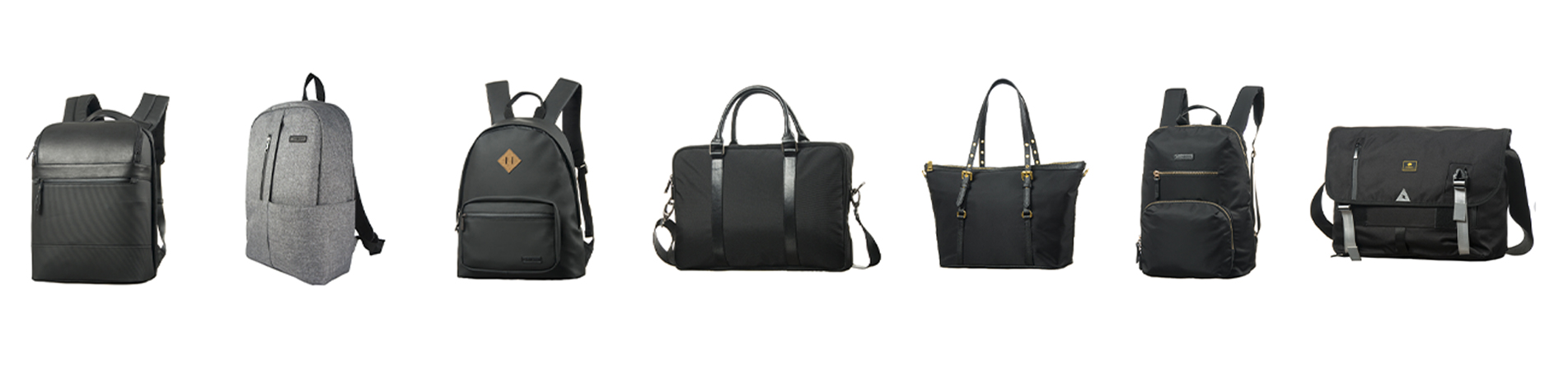
AQL staat voor Aanvaardbare kwaliteitslimiet (Acceptable Quality Level). Dit is een statistische steekproefmethode die veelvuldig wordt gebruikt in de wereldwijde maakindustrie om te bepalen of een partij geproduceerde goederen voldoet aan vooraf vastgestelde kwaliteitsnormen. Bij grote zendingen is het inspecteren van elk afzonderlijk artikel niet alleen extreem kostbaar, maar ook zeer tijdrovend. AQL stelt kwaliteitsinspecteurs in staat een representatieve steekproef te inspecteren en een statistisch onderbouwde conclusie te trekken over de gehele partij goederen.
Dit concept werd formeel vastgelegd door de Internationale Organisatie voor Standaardisatie (ISO) in de ISO 2859-1-norm en is breed geaccepteerd in de militaire, medische, consumentenelektronica- en textielindustrie. In de tassenindustrie fungeert AQL als een gemeenschappelijke taal tussen merken en tassenfabrikanten. Het elimineert onduidelijkheden en biedt zowel kopers als verkopers een kwantitatieve referentiestandaard – specifiek het aantal defecte artikelen dat acceptabel is bij één enkele inspectie volgens de AQL-steekproefrichtlijnen.
Voordat we AQL bespreken, is het belangrijk om eerst te begrijpen wat defecten zijn, oftewel gebrekkige producten. Bij grootschalige productie zijn defecten van verschillende ernst onvermijdelijk en kunnen ze de financiële belangen van de koper direct beïnvloeden.
De inspectie wordt voornamelijk uitgevoerd door middel van een eindinspectie met willekeurige steekproeven, met als doel een objectieve en meetbare kwaliteitsbeoordeling te geven van de partij producten die de koper gaat ontvangen. Op basis van de inspectieresultaten kan de koper inzicht krijgen in eventuele gebreken in de partij en vervolgens beslissingen nemen over de afhandeling van de goederen.
Verschillende kopers kunnen verschillende opvattingen hebben over wat een defect precies inhoudt. Defecten kunnen verder worden onderverdeeld in kritieke defecten, grote defecten en kleine defecten. Over het algemeen zullen kopers de definities van deze defecten duidelijk specificeren in hun inspectieprocedures of handleidingen voor inspecteurs.
In het algemeen kunnen deze drie soorten defecten als volgt worden verklaard:
De AQL-tabel is een statistisch hulpmiddel dat inkoopinspecteurs kunnen gebruiken bij productinspecties en is tevens een industriestandaard. De standaard bestaat in principe uit twee tabellen. De eerste tabel geeft aan welke codeletter moet worden gebruikt. Vervolgens kan op basis van de codeletter de bijbehorende steekproefomvang en het maximaal acceptabele aantal defecten worden bepaald.
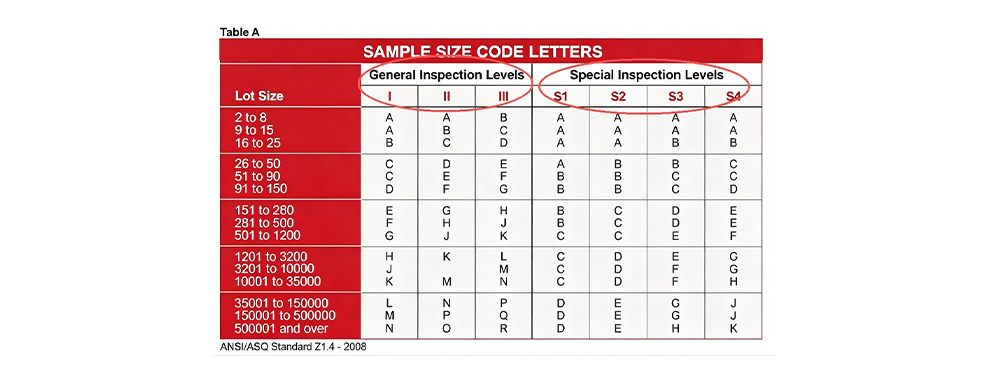
De bovenstaande tabel is gebaseerd op de ANSI/ASQ Z1.4-2008-norm van de Verenigde Staten (die over het algemeen overeenkomt met de ISO 2859-1-norm).
Om de eerste tabel te begrijpen, moet u eerst weten wat "Algemene inspectieniveaus" en "Speciale inspectieniveaus" betekenen.
Algemene inspectieniveaus
Niveau | Steekproefomvang | Onderscheidingsvermogen | Standaarddefinitie en selectiereferentie |
I | Kleiner | Lager | Deze methode wordt gebruikt wanneer een relatief kleine inspectie volstaat om aan de eisen te voldoen, of wanneer de productkwaliteit gedurende een lange periode stabiel is gebleven en inspectiekosten een probleem vormen. |
II | Medium | Medium | Standaardniveau. Tenzij anders aangegeven, dient niveau II te worden gebruikt. Dit niveau is van toepassing op de inspectie van de overgrote meerderheid van gangbare consumentenproducten. |
III | Groter | Hoger | Wordt gebruikt wanneer een groter onderscheidingsvermogen vereist is. Toepasbaar op nieuwe producten, producten met aanzienlijke kwaliteitsschommelingen, producten met een hoge eenheidsprijs, kritische componenten, producten met speciale kwaliteitseisen van de klant, situaties waarin de gevolgen van een afgekeurde partij ernstig zijn, en andere vergelijkbare scenario's. |
Speciale inspectieniveaus
De kerndefinitie van S1–S4 is: “Wordt gebruikt wanneer relatief kleine steekproefgroottes nodig zijn en een groter steekproefrisico kan worden getolereerd.”
Niveau | Steekproefomvang | Typische toepassingsscenario's | Referentie voor coördinatie met AQL |
S-1 | Extreem klein | Uitsluitend te gebruiken voor zeer eenvoudige controles en scenario's met een zeer laag risico. | AQL ≥ 1,5 (aanbevolen door sommige sectoren) |
S-2 | Heel klein | Goede verwerkingsomstandigheden, zeer uniforme kwaliteit binnen de partij, eenvoudige verificatie. | AQL ≥ 1,0 |
S-3 | Klein | Kwaliteitskenmerken worden bepaald door het ontwerp/de structuur; producten die niet handmatig worden geassembleerd. | AQL ≥ 0,25 |
S-4 | Relatief klein | De inspectiekosten zijn extreem hoog, de inspectiecycli zijn lang of de test is destructief. | AQL ≥ 0,10 |
Let op: Speciale inspectieniveaus worden over het algemeen niet gebruikt voor een uitgebreide inspectie van een volledige partij producten. Ze zijn eerder bedoeld voor bepaalde specifieke testonderdelen op een inspectielijst, zoals destructief onderzoek, functioneel onderzoek, veiligheidsonderzoek en andere soortgelijke tests. Daarom wordt voor de meeste standaardorders doorgaans inspectieniveau II gebruikt.
Nadat u de inspectieniveaus hebt begrepen, kunt u de norm "II" gebruiken om tabel A te raadplegen en de bijbehorende steekproefomvang te selecteren. Als uw bestelhoeveelheid bijvoorbeeld tussen de 3.201 en 10.000 eenheden ligt, is de bijbehorende codeletter voor de steekproefomvang "L".
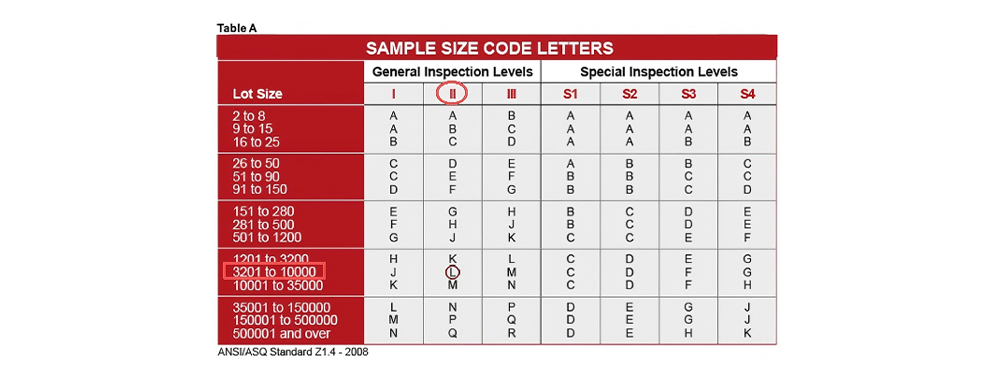
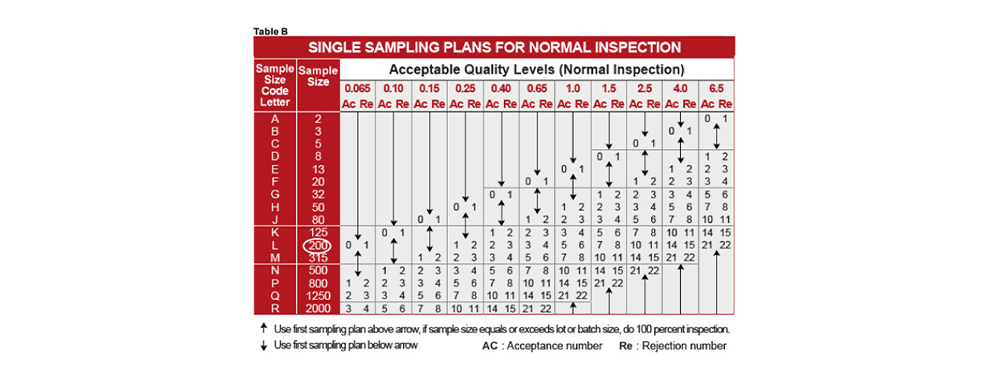
Gebruik de waarde "L" uit tabel A als referentie; de corresponderende steekproefomvang voor rij "L" in tabel B is 200. Raadpleeg vervolgens de door het merk of de fabrikant van de zakken vastgestelde AQL-normen om het bijbehorende acceptatienummer (Ac) en afwijzingsnummer (Re) te bepalen.
Neem bijvoorbeeld de AQL 2.5/4.0, die momenteel veelvuldig wordt toegepast voor massaproducten:
AQL 2.5 betekent dat het acceptatienummer (Ac) voor grote defecten 10 is, terwijl het afkeuringsnummer (Re) 11 is; AQL 4.0 betekent dat het acceptatienummer (Ac) voor kleine defecten 14 is, terwijl het afkeuringsnummer (Re) 15 is.
Dit betekent dat van de 200 geïnspecteerde monsters, als het aantal ernstige defecten niet meer dan 10 en het aantal lichte defecten niet meer dan 14 bedraagt, de partij als acceptabel wordt beschouwd. Omgekeerd, als het aantal defecten van een van beide typen het corresponderende afkeuringsgetal bereikt of overschrijdt, wordt de gehele partij als onacceptabel beschouwd.
Door de totale orderhoeveelheid, het inspectieniveau en de AQL-waarde op deze manier te combineren, kunnen merken op wetenschappelijke wijze de steekproefomvang en acceptatiedrempels bepalen. Dit zorgt ervoor dat de kwaliteitscontrole zowel in overeenstemming is met statistische principes als aansluit bij de daadwerkelijke bedrijfsbehoeften.
Bij SYNBERRY BAG is ons kwaliteitsborgingssysteem gebaseerd op hoge normen: 0% voor kritieke defecten, AQL 1,5 voor ernstige defecten en AQL 4,0 voor kleine defecten. Deze gecombineerde strategie is ontworpen om ervoor te zorgen dat onze producten niet alleen voldoen aan de minimale eisen op het gebied van veiligheid en wettelijke naleving, maar ook aan de belangrijkste verwachtingen van de consument wat betreft functionaliteit en uiterlijk.
Een kritisch defectniveau van nul betekent dat zodra er een fataal probleem wordt ontdekt in de bemonsterde eenheden, ongeacht de hoeveelheid, dat de veiligheid van de gebruiker in gevaar kan brengen of wet- en regelgeving kan overtreden, de gehele partij direct als onacceptabel wordt beschouwd en volledig opnieuw moet worden bewerkt. Dit is een niet-onderhandelbare grens en weerspiegelt de hoge mate van verantwoordelijkheid die het merk neemt ten aanzien van de veiligheid van de consument.
Dit soort defecten betreffen de kernfunctionaliteit van het product of aanzienlijke uiterlijke gebreken, zoals een vastgelopen rits, loszittende handvatten, verkeerd afgedrukte logo's of duidelijke kleurverschillen. Dergelijke defecten leiden vaak tot retourzendingen of klachten van consumenten, wat de reputatie van het merk direct schaadt.
Voor dit soort defecten hanteren we een hogere inspectienorm dan de gebruikelijke commerciële norm (AQL 2.5): AQL 1.5. Neem bijvoorbeeld een steekproef van 200: het acceptatiegetal (Ac) voor ernstige defecten onder AQL 1.5 is 7 en het afkeuringsgetal (Re) is 8.
Dit betekent dat bij statistische steekproeven het toelaatbare percentage ernstige defecten extreem laag is. Het vereist dat de fabriek strikte controles uitvoert op kritieke processen tijdens de productie om te garanderen dat de functionaliteit en het uiterlijk van het product aan hoge eisen voldoen.
Voor kleine onvolkomenheden die de bruikbaarheid of functionaliteit niet beïnvloeden en die alleen bij nauwkeurige inspectie van dichtbij kunnen worden opgemerkt, zoals losse draadjes of kleine vlekjes op niet-dragende delen van de voering, hanteren we de AQL 4.0-norm voor kleine defecten. Hoewel deze problemen het product niet onbruikbaar maken, kan een te hoog aantal gevallen wel de perceptie van de consument over de kwaliteit van het merk negatief beïnvloeden.
Het vaststellen van AQL 4.0 betekent niet dat kwaliteitsproblemen onopgemerkt mogen blijven. Het vertegenwoordigt eerder een rationeel evenwicht tussen perfectionisme en het waarborgen van de algehele efficiëntie van de verzending en het beheersbaar houden van de kosten. Het zorgt ervoor dat de overgrote meerderheid van de producten die aan consumenten worden geleverd, een schone, gestandaardiseerde en representatieve uitstraling behoudt.
Dankzij dit gelaagde kwaliteitscontrolesysteem kan SYNBERRY BAG de kernkwaliteit en -veiligheid waarborgen en tegelijkertijd de toewijzing van productiemiddelen optimaliseren. Zo biedt het merken een betrouwbare én kosteneffectieve leveringsoplossing van hoge kwaliteit.
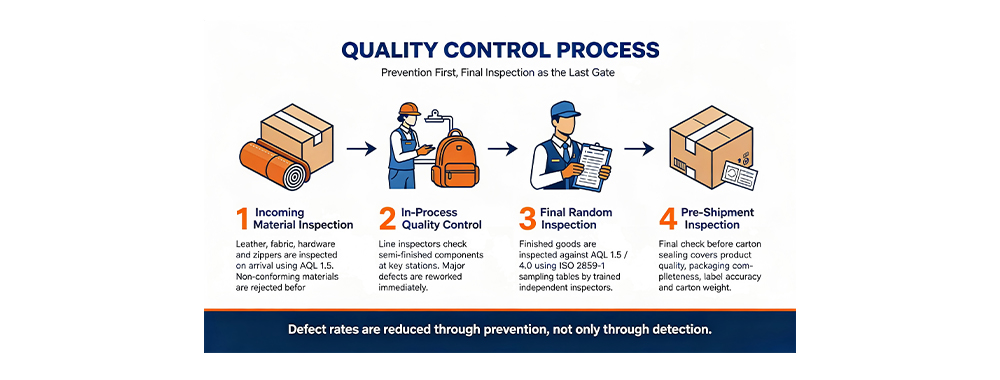
Onze implementatie volgt een strikt meerstappenproces:
Grondstoffen – waaronder leer, stoffen, fournituren en ritsen – worden direct na aankomst gecontroleerd volgens AQL 1.5. Niet-conforme materialen worden nooit in het productieproces toegelaten.
Productielijninspecteurs controleren halffabrikaten op kritieke werkstations. Ernstige defecten die in dit stadium worden geconstateerd, worden direct verholpen om te voorkomen dat ze permanente defecten in de eindproducten worden.
De eindproducten worden geïnspecteerd volgens de AQL 1.5/4.0-norm, met behulp van de steekproeftabellen zoals gespecificeerd in ANSI/ASQ Z1.4-2008 of ISO 2859-1. De inspectie wordt uitgevoerd door getrainde kwaliteitsinspecteurs die onafhankelijk zijn van het productieteam.
De laatste controle vindt plaats voordat de dozen worden verzegeld. Hierbij wordt niet alleen de productkwaliteit gecontroleerd, maar ook de integriteit van de verpakking, de juistheid van de etiketten en het gewicht van de doos.
Deze gelaagde aanpak betekent dat tegen de tijd dat een partij goederen de eindinspectie bereikt, het defectpercentage al aanzienlijk is verlaagd door preventie in plaats van detectie. De AQL-norm fungeert als de laatste poortwachter, in plaats van het primaire kwaliteitscontrole-instrument.
Het begrijpen van de theorie achter AQL is slechts de eerste stap. In de praktijk kunnen merken, in samenwerking met een tassenfabriek of handtassenfabrikant, ook te maken krijgen met diverse vragen en onzekerheden over de implementatie. Op basis van onze jarenlange ervaring met klanten wereldwijd hebben we de volgende veelgestelde vragen en gedetailleerde antwoorden samengesteld.
A: De AQL-steekproefgrootte wordt niet willekeurig bepaald door de fabriek of het merk. Deze volgt strikt de overeenkomstige relaties die zijn gespecificeerd in de steekproeftabellen. De norm gebruikt Algemeen Inspectieniveau II als standaard. Op basis van de totale hoeveelheid van de gehele partij (partijgrootte) wordt een steekproefgroottecodeletter bepaald, en de bijbehorende code wordt vervolgens gekoppeld aan het specifieke aantal te inspecteren eenheden.
Een merk heeft uiteraard het recht om een strenger inspectieniveau te eisen, zoals overschakelen naar inspectieniveau III (waarbij de steekproefomvang met ongeveer anderhalf keer toeneemt) of een verscherpte inspectie vereisen. Twee punten moeten echter duidelijk worden begrepen: ten eerste verlengt een grotere steekproefomvang de inspectieperiode en brengt dit extra arbeidskosten met zich mee; ten tweede leidt een grotere steekproefomvang niet tot een evenredige toename van het percentage gedetecteerde defecten, omdat de kern van AQL een waarschijnlijkheidsmodel is en niet simpelweg een verhoging van het aantal geïnspecteerde eenheden.
A: Elke aanpak heeft zijn eigen voor- en nadelen, afhankelijk van hoe het merk objectiviteit en kostenbeheersing in balans brengt.
Fabrieksinspectie zelf: De voordelen van fabrieksinspectie zelf zijn onder andere een snelle respons, lage kosten en de mogelijkheid om direct feedback te geven op productieproblemen, zodat snel herstelwerkzaamheden kunnen worden uitgevoerd. De beperking is echter het gebrek aan onafhankelijkheid. Er kan sprake zijn van een belangenconflict waarbij de fabriek in feite "zowel de speler als de rechter" is, wat kan leiden tot inspectieresultaten die te mild uitvallen. Als echter een leverancier met een eigen, strikt kwaliteitscontrolesysteem wordt gekozen, kan dit risico aanzienlijk worden verminderd.
Inspectie door derden: De voordelen van inspectie door derden, zoals SGS, Bureau Veritas of inspectiebureaus die door het merk zelf zijn aangewezen, zijn onder andere onafhankelijkheid en een uitgebreid netwerk van vestigingen. Voor sommige grote retailers met leveranciers verspreid over meerdere regio's wereldwijd biedt inspectie door derden gemak en consistentie. Kleinere merken beschikken daarentegen mogelijk niet over een volledig intern kwaliteitscontrolesysteem (QA/QC) en vertrouwen soms op het professionele oordeel van inspectiebureaus door derden om hun interne capaciteiten te compenseren.
De belangrijkste beperkingen van inspectie door derden zijn de relatief hoge kosten en het feit dat dergelijke inspecties doorgaans alleen de toestand van de goederen op de inspectiedag weergeven. Het is voor externe inspecteurs moeilijk om net zo diepgaand betrokken te zijn bij het gehele productieproces en de kwaliteitscontroleactiviteiten als een intern team.
A: Afwijzing betekent niet dat de hele partij goederen moet worden afgekeurd. De gebruikelijke afhandeling omvat:
In de kwaliteitsovereenkomst van SYNBERRY BAG verbinden we ons er expliciet toe dat als een eindinspectie wordt afgekeurd om redenen die aan ons te wijten zijn, wij de daaruit voortvloeiende herstelkosten en de aansprakelijkheid voor vertraagde levering zullen dragen, zodat de commerciële belangen van het merk niet worden geschaad.
A: AQL is een algemene statistische steekproefmethode en kan in principe worden toegepast op producten in alle productie-industrieën. In specifieke toepassingen moet de methode echter flexibel worden aangepast aan de kenmerken van het product. Voor structureel complexe producten met extreem hoge eisen aan vakmanschap, zoals luxe handtassen of premium zakelijke rugzakken, is het gebruik van alleen AQL-steekproeven mogelijk niet voldoende om alle potentiële risicopunten te dekken. Dergelijke producten vereisen vaak strengere tests en een hoger inspectieniveau, zoals niveau III.
A: Dit weerspiegelt verschillen in merkpositionering, doelgroepen en risicotolerantie. Massamarktmerken in de fast-fashionsector kiezen mogelijk voor AQL 2.5/4.0 om een balans te vinden tussen kosten en levertijd, terwijl bekende of premium tassenmerken wellicht kiezen voor AQL 1.5/4.0, of zelfs aangepaste inspectienormen met hun fabrieken vaststellen, om hun merkimago te behouden en een hoge prijs te kunnen vragen.
SYNBERRY BAG kiest bewust voor AQL 1.5/4.0 om merkklanten te helpen een onderscheidend concurrentievoordeel te behalen door middel van superieure kwaliteitsdetails in een zeer competitieve markt, met zeer weinig klachten na de aankoop, waardoor de klantwaarde op lange termijn wordt verhoogd.
Productinspectie is essentieel om de kwaliteit van goederen vóór verzending te beoordelen. Effectief gebruik van de AQL-norm kan diepgaand inzicht in de kwaliteit bieden en een objectieve meetmethode vormen, waardoor inkopers van tassen (OEM's) relevante inkoopbeslissingen kunnen nemen.
Als een merk hulp nodig heeft bij het ontwikkelen van een inspectieplan en inspectie-eisen, bieden wij graag ondersteuning door onze professionele kennis en ervaring in de branche in te zetten.
| Auteur | ||||||
|
Lees verder, blijf op de hoogte, abonneer u en wij heten u van harte welkom om ons te vertellen wat u ervan vindt.




auteursrechten
@2024 Synberry Bag & Package Products Co.,Ltd Alle rechten voorbehouden
.
 NETWERK ONDERSTEUND
Sitemap / bloggen / Xml / Privacybeleid